

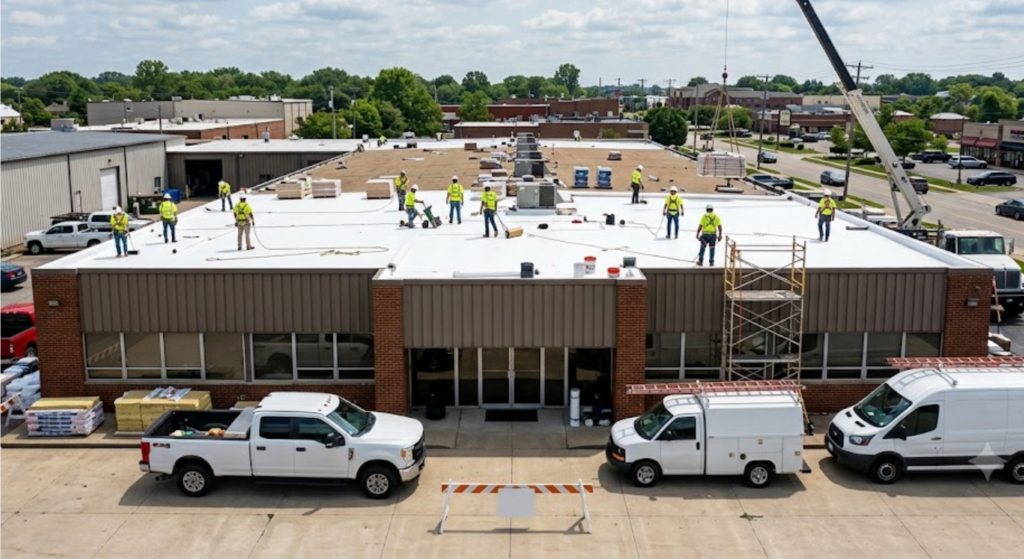
For commercial property managers, industrial facility owners, and real estate investors in the Fairfield region, the roofing system is one of the most critical structural assets under your care. A commercial flat or low-slope roof is a complex engineering barrier designed to protect expensive inventory, sensitive mechanical equipment, and daily business operations from the unpredictable Ohio Valley climate.
When your roofing system reaches the end of its service life, develops chronic leaks, or suffers storm damage, selecting the right contractor is a high-stakes decision. Entrusting a multi-thousand-square-foot facility to an unqualified or transient contractor can lead to catastrophic interior water damage, voided material warranties, and severe operational downtime. Clients trust Fairfield commercial roofing company for leak repairs, roof coatings, and complete installations backed by manufacturer warranties.
To ensure your capital investment yields decades of reliable protection, you must subject potential contractors to a rigorous evaluation process. Here is a comprehensive guide on what to scrutinize before signing a commercial roofing contract.
1. Verify Manufacturer Certifications and Warranty Capabilities
In commercial roofing, a contractor’s workmanship is directly tied to their relationship with major material manufacturers. Leading commercial roofing brands such as GAF, Carlisle SynTec, Firestone (Elevate), and Johns Manville do not allow just any contractor to install their systems. They enforce strict training programs, rigorous financial audits, and mandatory on-site quality inspections.
When vetting a contractor, demand proof of their manufacturer certification level. A factory-certified contractor is authorized to offer No Dollar Limit (NDL) warranties.
- Why NDL Warranties Matter: Unlike standard contractor guarantees that cap repair costs or cover only basic materials, an NDL warranty is backed directly by the manufacturer. It covers 100% of the material and labor costs required to repair leaks caused by product defects or workmanship errors for up to 20 or 30 years, with no financial ceiling.
- The Inspection Gate: Manufacturers will only issue an NDL warranty after their own technical representative inspects and approves the finished roof. If a contractor cannot offer an NDL warranty, it is a glaring red flag that their work does not meet industry standards.
2. Evaluate System Versatility and Technical Expertise
Commercial roofs are not one-size-fits-all. A sprawling logistics warehouse requires a completely different thermal and waterproofing strategy than a restaurant with heavy grease exhaust or a medical building with rooftop HVAC units. A reputable Fairfield contractor should demonstrate mastery across all major commercial roofing systems rather than aggressively pushing a single product.
Ensure your contractor has proven expertise in the following technologies:
- Thermoplastic Polyolefin (TPO): White, highly reflective single-ply membranes that slash summer air conditioning costs and offer superior resistance to ultraviolet (UV) radiation and ozone.
- Ethylene Propylene Diene Monomer (EPDM): Durable synthetic rubber membranes renowned for their industry-leading longevity and flexibility during freezing winter weather.
- Polyvinyl Chloride (PVC): Chemical-resistant single-ply membranes designed specifically for facilities exposed to animal fats, greases, and industrial pollutants.
- Fluid-Applied Roof Restorations: Advanced silicone and acrylic coatings that seal structurally sound, aging roofs, extending their functional life by up to 15 years at a fraction of the cost of a full tear-off.
Technical Comparison: Evaluating Contractor Tiers
| Evaluation Criteria | Professional Regional Specialist | Low-Bid / Transient Contractor |
| Warranty Protection | Factory-certified to issue manufacturer-backed NDL warranties. | Offers limited, contractor-only guarantees with material caps. |
| Diagnostic Methods | Uses infrared thermography and core sampling to verify substrate health. | Relies solely on surface-level visual inspections. |
| Safety Compliance | Maintains low EMR safety scores and strict OSHA fall-protection protocols. | Lacks documented safety programs; creates liability risks. |
| Operational Continuity | Phased scheduling and off-hours work to ensure zero business disruption. | Standard hours; disruptive noise, debris, and blocked access lanes. |
3. Scrutinize Diagnostic Capabilities and Core Sampling
A professional commercial roofing evaluation should look beneath the surface. If a contractor submits a proposal after merely walking the roof and looking at the outer membrane, throw the bid out. Modern commercial roofing evaluations require deep scientific diagnostics to assess the true health of the roof assembly.
Elite contractors utilize infrared thermography (thermal imaging drones or handheld cameras) to scan the roof after sunset. Saturated insulation holds heat longer than dry insulation, glowing clearly on thermal scans. By pairing thermal imaging with physical core sampling, extracting a small cylinder of the roof down to the structural deck, a contractor can precisely measure insulation moisture levels, deck integrity, and material thickness. This prevents you from paying for a massive structural tear-off when a targeted restoration coating would suffice, or conversely, installing a new membrane over rotting, wet insulation.
4. Prioritize Local Accountability and Emergency Mobilization
The Ohio Valley climate subjects commercial roofs to severe freeze-thaw cycles, high-wind storm cells, and heavy summer rain. When severe weather hits, out-of-state “storm chasers” flood the market, offering fast repairs and low bids. However, once the storm season ends, these transient crews leave the state, making warranty follow-ups or emergency leak callbacks virtually impossible.
Partnering with an established Fairfield-based contractor guarantees direct regional accountability. Look for a company with a physical brick-and-mortar office, local equipment yards, and in-house maintenance crews. When an active leak threatens your server room or inventory, a local specialist can mobilize within hours to apply temporary waterproof membranes, mitigate interior damage, and execute permanent repairs once the weather clears.
5. Assess Safety Protocols and Operational Continuity
Commercial roof construction involves heavy machinery, open flames, hot bitumen, and elevated heights. A contractor with poor safety standards puts your property and your business at significant legal risk. Always request a prospective contractor’s Experience Modification Rate (EMR) and their OSHA compliance records. An EMR score below 1.0 indicates a superior safety record, reducing the risk of job-site accidents and workers’ compensation lawsuits.
Furthermore, discuss operational continuity before signing. A professional contractor engineers their work schedule around your business operations. They coordinate material deliveries, crane lifts, and dumpster placements to ensure shipping docks, customer entrances, and fire lanes remain completely unobstructed. By utilizing phased installation techniques and scheduling noise-heavy demolition during off-hours, an elite contractor ensures your daily operations continue without disruption.
Conclusion
Evaluating a commercial roofing company in Fairfield requires looking far beyond the bottom line of an initial estimate. The true cost of a roof is measured over its 20- to 30-year lifecycle. By vetting a contractor’s manufacturer certifications, insisting on advanced diagnostic testing, prioritizing regional accountability, and verifying their safety standards, you protect your building’s structural integrity. Investing time in a rigorous evaluation process ensures you partner with a craftsman capable of delivering a durable, high-performance roofing system that keeps your business covered for decades to come.
Frequently Asked Questions (FAQ)
Q: How do I know if my building needs a complete roof replacement or a restoration coating?
A: The decision depends on the condition of the underlying insulation and structural deck. A contractor should perform an infrared moisture scan and take core samples. If more than 25% of the insulation is saturated with water, a full tear-off and replacement is generally required. If the insulation is dry and the membrane is simply weathered, an elastomeric or silicone restoration coating can seal the roof and extend its life by 10 to 15 years at up to half the cost.
Q: How often should a commercial flat roof be professionally inspected?
A: Industry best practices recommend that commercial roofs undergo a comprehensive inspection twice a year—ideally in the spring to assess winter freeze damage and in the fall to prepare drainage systems for autumn leaves and winter snow. Additional inspections should occur immediately following severe hail or wind storms.
Q: What is ponding water, and how dangerous is it to a commercial roof?
A: Ponding water is defined as any water that remains on a flat roof 48 hours after rain has stopped. It is highly hazardous because water weighs roughly 62.4 pounds per cubic foot, adding immense structural dead-load stress to building joists. Furthermore, standing water acts as a magnifying glass for UV rays, accelerating membrane breakdown and voiding most manufacturer warranties.