

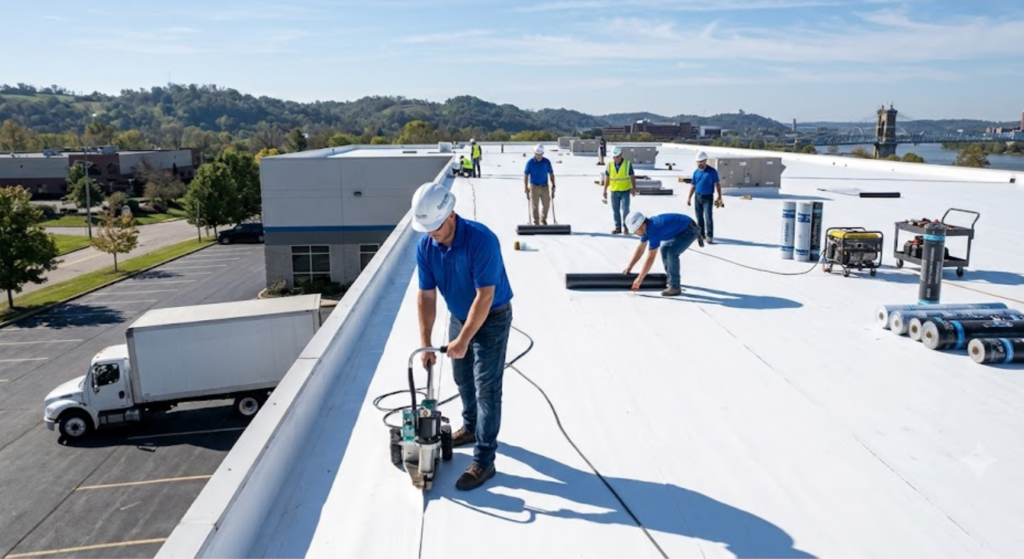
Operating a commercial facility in the Northern Kentucky region presents a unique set of infrastructural challenges. Whether you manage a sprawling logistics warehouse in Florence, a retail center in Covington, or a corporate office park in Newport, your building is constantly battling a highly dynamic, four-season climate. The roof of your commercial property serves as the ultimate shield against freezing winter ice storms, torrential spring rains, and blistering summer heat waves.
Because commercial buildings typically utilize flat or low-slope roofing systems, the early warning signs of structural wear and tear are rarely visible from the ground. It is incredibly easy for minor, highly repairable defects to go unnoticed until they evolve into catastrophic internal leaks that halt your business operations. Proactive facility management is the key to preserving your building’s equity and protecting your inventory. Partnering with dedicated Commercial roofing contractors Northern Kentucky helps reduce downtime and long-term costs with preventative maintenance and durable roofing solutions.
Understanding and identifying the top signs that your commercial roof is failing allows you to intervene early, saving your company from massive emergency capital expenditures.
1. Interior Water Infiltration and Persistent Moisture
The most alarming and undeniable sign that you need to contact a commercial roofing contractor immediately is the presence of water inside your facility. Unlike residential pitched roofs where a leak usually drips directly below the damaged shingle, water entering a commercial flat roof can travel extensively. It will navigate along corrugated steel decking, concrete slabs, and internal beams for hundreds of feet before finally dropping onto your factory floor or retail space.
Facility managers should be on high alert for the following internal symptoms:
- Discolored Acoustic Ceiling Tiles: The sudden appearance of yellow or brown water rings on suspended ceiling grids.
- Peeling and Blistering Wall Paint: Moisture trapped within masonry blocks or drywall that forces the interior commercial paint or epoxy coatings to bubble outward.
- Lingering Musty Odors: A persistent smell of mold or mildew in the upper sub-ceilings, indicating that the roofing insulation has been wet for a prolonged period.
2. Visible Degradation of the Roofing Membrane
Most modern commercial roofs in Northern Kentucky rely on single-ply membrane systems, such as Thermoplastic Polyolefin (TPO), Polyvinyl Chloride (PVC), or Ethylene Propylene Diene Monomer (EPDM) rubber. While these materials are incredibly resilient, they are not immune to decades of intense ultraviolet (UV) radiation and severe thermal shock.
During a routine visual inspection of your rooftop, you may notice distinct physical deformities in the membrane. Blistering occurs when moisture or air is trapped beneath the membrane; as the summer sun heats the roof, this trapped moisture vaporizes and expands, creating large, raised bubbles that stretch and weaken the material. Additionally, keep a close eye on the welded or chemically adhered seams. If you spot edge curling, seam separation, or physical tearing along the overlap lines, the watertight integrity of your entire system has been severely compromised and requires immediate professional heat-welding repairs.
3. The Accumulation of Chronic Ponding Water
By strict commercial building code standards, a properly engineered flat roof must be capable of draining standing water entirely within 48 hours following a rainstorm. If you access your roof days after a Northern Kentucky downpour and find deep pools of water stagnating on the surface, your roof is suffering from a condition known as ponding water.
Ponding water is highly destructive to commercial properties for several reasons. First, water is exceptionally heavy—weighing roughly 62.4 pounds per cubic foot. Massive pools place immense dead-load stress on your building’s structural joists. Second, standing water acts like a magnifying glass, focusing the sun’s UV rays to literally cook the membrane beneath it, accelerating the breakdown of essential adhesives. A specialized commercial roofer can permanently resolve this by clearing internal drain blockages, widening exterior scuppers, or installing a custom tapered insulation system to forcibly direct the water toward the proper drainage points.
4. Unexplained Spikes in Commercial Energy Bills
Your commercial roof is a vital component of your building’s overall thermal envelope. Beneath the waterproof outer membrane lies a thick layer of rigid polyisocyanurate (ISO) insulation boards. This insulation layer is responsible for keeping the conditioned air inside your facility stable keeping heating costs low during freezing Kentucky winters and reducing air conditioning loads during humid summers.
If your accounting department notices a sudden, sharp, and unexplained spike in your monthly utility expenses, a hidden roof leak is a likely culprit. When water penetrates the outer membrane, it acts like a sponge, saturating the ISO insulation boards. Once commercial insulation becomes wet, it permanently loses its R-value (thermal resistance). Your building essentially develops a thermal short-circuit, allowing massive amounts of heated or cooled air to escape straight through the roof deck. Professional roofing contractors utilize advanced infrared drone technology to scan your roof, instantly pinpointing these hidden pockets of wet insulation for targeted replacement.
[ Commercial Roofing Threat Matrix ]
      |
      +---> Structural Dead-Load Stress (Caused by Ponding Water)
      |
      +---> Thermal Short-Circuiting (Caused by Saturated ISO Insulation)
      |
      +---> Seam Ruptures (Caused by UV Degradation and Thermal Shock)
      |
      +---> Interior Asset Damage (Caused by Membrane Punctures)
5. Reaching the End of the Manufacturer Warranty Lifecycle
Even the most meticulously maintained commercial roofing systems have a finite lifespan. Standard single-ply systems generally offer a service life of 20 to 30 years. If your building’s roof is approaching the end of its original No-Dollar-Limit (NDL) manufacturer warranty, it is time to bring in a professional contractor for a comprehensive audit.
Rather than waiting for the aging system to fail entirely which often mandates a complete, highly expensive structural tear-off a commercial expert can evaluate the roof for an advanced fluid-applied restoration coating. If the underlying insulation remains dry, applying a commercial-grade silicone or acrylic coating can completely restore the roof’s waterproofing capabilities, extend its life by another decade, and significantly lower your cooling costs, all for a fraction of the price of a full replacement.
Proactive vs. Reactive: The Strategic Value of Local Expertise
| Facility Strategy | Working With A Proactive Commercial Expert | Relying On Reactive Emergency Repairs |
| Budget Control | Predictable, manageable annual maintenance costs. | Massive, unbudgeted capital expense shocks. |
| Business Operations | Maintenance performed during off-hours with zero disruption. | Sudden facility closures due to indoor flooding. |
| Asset Lifespan | Maximizes the full 30-year potential of the roof system. | Leads to premature roof failure and early replacement. |
| Warranty Status | Detailed service records keep NDL warranties fully active. | Neglect and unverified repairs frequently void warranties. |
Conclusion
The roof over your commercial facility is a highly valuable, income-protecting asset. Ignoring the early warning signs of degradation from subtle ceiling stains and blistering membranes to chronic ponding water and skyrocketing energy costs—is a gamble that invariably leads to severe operational disruptions and staggering financial losses. By maintaining a sharp eye for these indicators and partnering with a dedicated, highly trained regional specialist, you can transition your facility from a reactive crisis model into a proactive management strategy. Investing in professional commercial roofing services in Northern Kentucky guarantees that your building remains strictly code-compliant, perfectly insulated, and thoroughly protected against the elements for decades to come.
Frequently Asked Questions (FAQ)
Q: How frequently should a commercial roof in Northern Kentucky be professionally inspected?
A: Industry best practices recommend that commercial flat roofs undergo a comprehensive professional inspection at least twice a year, ideally in the spring to assess any damage from winter ice, and in the fall to prepare the drainage systems for the coming snow.
Q: What is a core cut, and why do commercial roofers perform them?
A: A core cut is a diagnostic procedure where a roofing technician extracts a small, cylindrical sample of the roof, cutting through the membrane down to the structural deck. This allows the contractor to physically verify the exact type of insulation, measure the material thickness, and check for hidden moisture trapped beneath the surface.
Q: Can we apply a silicone roof coating over our existing TPO or EPDM roof?
A: Yes, provided the existing roof is a strong candidate. A commercial roofer must first perform an infrared moisture scan to ensure the underlying insulation is completely dry. If the structure is sound, a silicone coating can be applied seamlessly over the old membrane, providing a highly reflective, waterproof seal that extends the roof’s life without the cost of a tear-off.