

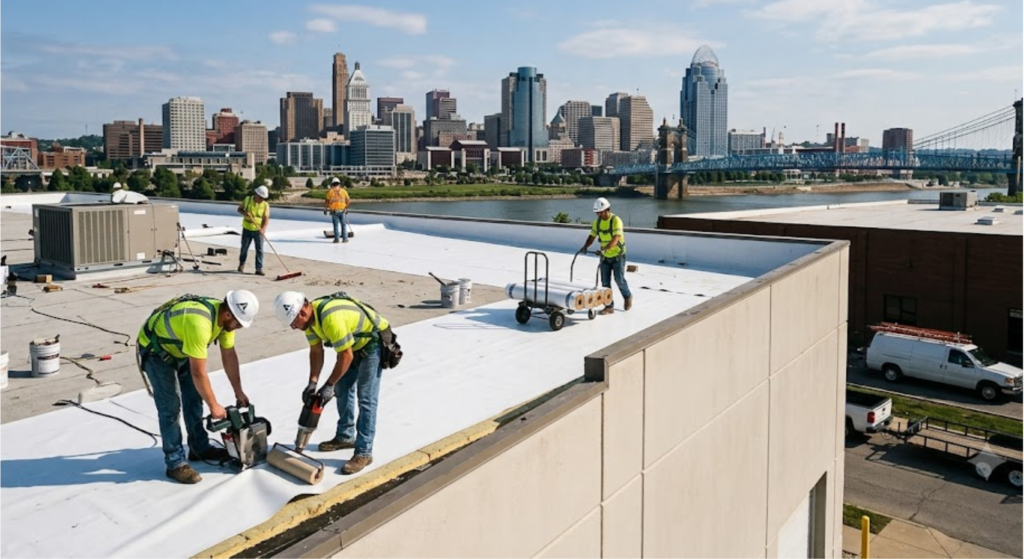
For commercial property owners, facility managers, and real estate investors, the building’s roof represents one of the most critical structural assets in their portfolio. A commercial roofing system does far more than simply cover the building; it safeguards valuable inventory, protects expensive mechanical equipment, maintains interior energy efficiency, and ensures a safe, comfortable environment for employees and tenants.
When that roof begins to age, develop chronic leaks, or suffer severe weather damage, leadership faces a pivotal decision: Do you outsource the project to a massive, out-of-state national contracting chain, or do you partner with an established, regional roofing specialist?
While large national firms may boast expansive marketing budgets, the tangible operational and financial benefits of choosing a regional expert are undeniable. With a strong local reputation, commercial roofing companies near me prioritizes communication, craftsmanship, and minimal disruption to operations. Navigating a major roof restoration or replacement with a trusted neighbor transforms a potentially stressful construction project into a seamless, highly managed investment. Here is an in-depth look at the distinct advantages of collaborating with a local commercial roofing contractor.
1. Rapid Emergency Response and Minimal Operational Disruption
When a commercial flat roof fails during a severe weather event, every minute of water infiltration translates directly into financial loss. Water pouring onto factory equipment, retail floors, or server rooms halts business operations, destroys assets, and creates severe slip-and-fall liabilities.
Out-of-town contractors or “storm chasers” often take days or weeks to mobilize crews, organize supply chains, and arrive on site. In contrast, local commercial roofing companies maintain dedicated crews, equipment fleets, and material warehousing right in your immediate region.
- Rapid Mobilization: When an emergency occurs, a local team can often dispatch repair crews within hours to install temporary waterproof tarps and mitigate active leaks before catastrophic interior damage occurs.
- Tailored Scheduling: Furthermore, local contractors are deeply attuned to the heartbeat of your business community. They understand the importance of keeping your facility open and will schedule heavy demolition, material cranes, and noisy installations during off-hours, weekends, or night shifts to guarantee absolute minimal disruption to your daily operations.
2. Deep Mastery of Regional Building Codes and Climate Profiles
No two geographical climates are identical, and what works perfectly for a warehouse in the arid Southwest will fail miserably on a retail complex in a humid, freeze-thaw northern environment. Commercial roofs are constantly battered by local meteorological stressors whether that involves high wind uplift, heavy snow loads, intense ultraviolet (UV) radiation, or driving hail.
Local commercial roofers possess invaluable, decades-long experience engineering roof systems specifically for your region’s microclimate. They know precisely which materials such as Thermoplastic Polyolefin (TPO), Ethylene Propylene Diene Monomer (EPDM), Polyvinyl Chloride (PVC), or multi-ply Modified Bitumen will deliver the highest longevity and energy efficiency in your exact weather profile.
Additionally, local contractors have established, daily working relationships with municipal building inspectors and zoning boards. They navigate regional building codes, stringent energy efficiency mandates, and local permitting processes with routine efficiency, preventing costly bureaucratic delays that can stall construction timelines.
[ Local Contractor Advantage Pipeline ]
      |
      +---> Rapid Mobilization (1 to 2 Hour Emergency Response Time)
      |
      +---> Strict Code Compliance (Intimate Knowledge of Local Municipalities)
      |
      +---> Tailored Climate Engineering (Materials Proven in Regional Weather)
      |
      +---> Direct Accountability (Physical Local Office & Executive Access)
3. Unmatched Accountability and Long-Term Warranty Protection
One of the greatest risks in commercial real estate maintenance is hiring a transient contractor who disappears once the final check clears. If a workmanship defect or material failure surfaces two years after installation, attempting to track down an out-of-state company often leads to unanswered phone calls and legal dead ends.
Local commercial roofing providers survive and thrive entirely on their regional reputation. Their physical brick-and-mortar headquarters is located right in your community, creating an unshakeable layer of direct accountability. Because top local contractors are factory-certified by leading commercial roofing manufacturers (such as Carlisle, GAF, Johns Manville, and Firestone/Elevate), they are authorized to offer robust, manufacturer-backed No Dollar Limit (NDL) warranties. If an issue arises during the 20- or 30-year warranty lifecycle, your contractor is just a short drive away, ready to honor their workmanship and protect your investment.
4. Proactive Asset Management and Personalized Communication
A commercial roof should never be treated as a one-off transactional purchase; it requires a proactive, long-term asset management strategy. National chains often shuttle clients through automated phone trees and distant call centers where you are treated as an account number rather than a valued business partner.
Working with a local company gives you direct, personal access to dedicated project managers, estimators, and even executive ownership. They take the time to conduct comprehensive, bi-annual maintenance evaluations utilizing advanced infrared thermography scans and core cut testing to identify hidden moisture trapped beneath the membrane long before it causes a structural deck failure. By establishing a customized, recurring maintenance partnership, local contractors extend the service life of your roofing system, helping you maximize every dollar of your capital expenditures.
Technical Comparison: National Chains vs. Dedicated Local Roofers
| Performance Metric | Out-of-State / National Chains | Dedicated Local Commercial Roofers |
| Emergency Speed | Slow mobilization; often requires days to deploy out-of-state crews. | Immediate dispatch; regional crews arrive on-site within hours. |
| Climate Engineering | Relies on standardized, generalized national material packages. | Custom-engineers material specs to survive specific local weather cycles. |
| Accountability | High risk of transient service; difficult warranty follow-up. | High local accountability; physical office down the street for immediate support. |
| Code Compliance | Unfamiliar with nuanced local zoning laws and municipal inspectors. | Intimate knowledge of local building codes, speeding up permitting. |
Conclusion
Your commercial property is the engine that drives your business operations, and the roof above it is its primary line of defense. Entrusting that asset to a contractor requires complete confidence in their technical capability, reliability, and integrity. Opting for a regional specialist eliminates the logistical headaches, impersonal communication, and long-term warranty risks associated with out-of-town operators.
By leveraging the speed, climate expertise, and unwavering accountability of a trusted local partner, you secure a durable, high-performance roofing system tailored specifically to your building’s needs. Invest wisely in your facility’s future by establishing a relationship with a local commercial roofing company that is dedicated to keeping your business covered, operating smoothly, and dry for decades to come.
Frequently Asked Questions (FAQ)
Q: What is the most common roofing membrane used for commercial flat roofs today?
A: Single-ply membranes, particularly TPO (Thermoplastic Polyolefin) and EPDM (Ethylene Propylene Diene Monomer), dominate the commercial roofing market. TPO is highly favored for its exceptional energy-reflecting white surface and heat-welded seams, while EPDM offers legendary durability and flexibility against hail and thermal shock.
Q: How often should a commercial flat roof undergo a professional inspection?
A: Industry best practices dictate that commercial roofs should be professionally inspected at least twice a year, typically in the spring and fall as well as immediately following any major meteorological event, such as a severe hailstorm, high-wind system, or blizzard.
Q: What is the difference between a roof repair, a roof restoration, and a full roof replacement?
A: A repair fixes localized issues such as punctures, split seams, or isolated flashing failures. A restoration involves applying a liquid-applied elastomeric or silicone coating over the existing membrane to seal leaks and extend the roof’s life by 10 to 15 years without a tear-off. A replacement is required when the underlying insulation is saturated or structural failure has occurred, necessitating the complete removal of the old roof down to the deck.