

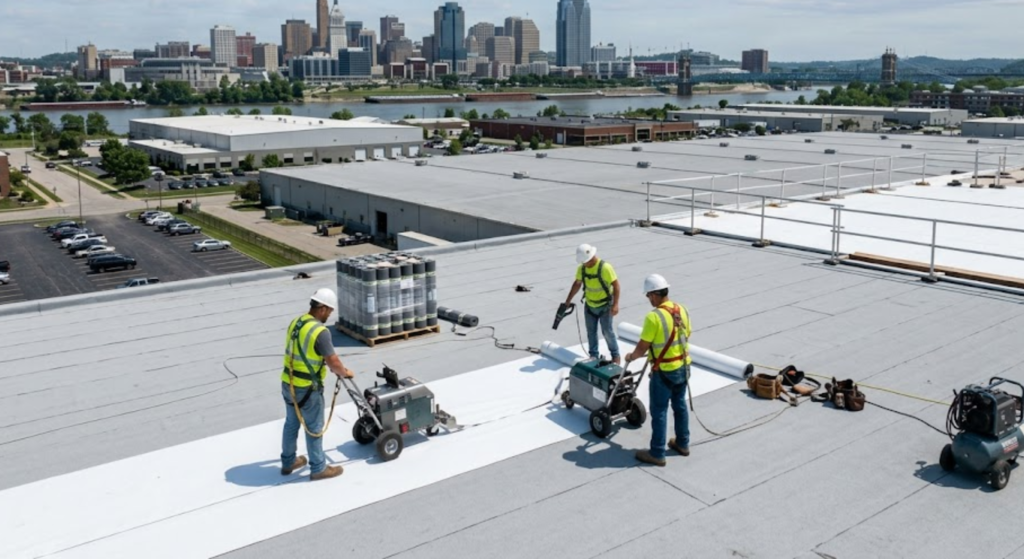
Managing a commercial property or industrial facility in Greater Cincinnati comes with an array of ongoing infrastructural responsibilities. Because the Ohio Valley experiences a highly volatile climate characterized by humid, blistering summers, severe spring convective storms, and freezing winter ice loads your building’s exterior envelope is under constant environmental stress. At the absolute apex of this defensive perimeter sits your commercial roof. A failing roof does not merely result in a minor internal inconvenience; it compromises your structural integrity, threatens expensive inventory, creates safety hazards for employees, and can force a complete halt to your daily business operations.
When it comes to repairing, maintaining, or completely replacing a low-slope or flat commercial roofing system, the stakes are incredibly high. This is a massive capital expenditure that requires precision engineering and master-level craftsmanship. Whether you’re budgeting for repairs or planning a full replacement, commercial roofing cincinnati oh offers clear guidance and honest pricing. To ensure your investment yields the highest possible return and completely protects your facility, you must follow strict industry standards during the hiring process. Here are the essential best practices for hiring a commercial roofing contractor in Cincinnati.
1. Verify Commercial-Specific Licensing and Insurance
It is a common and highly dangerous misconception among facility managers that residential roofing skills seamlessly translate to commercial structures. Residential roofing typically involves sloped surfaces and asphalt shingles, whereas commercial roofing requires a deep, technical understanding of complex flat-roof single-ply membranes, advanced drainage calculations, and heavy-duty structural engineering.
- Substantial Liability Insurance: Before allowing any contractor onto your property, demand proof of comprehensive general liability insurance tailored specifically for commercial projects. This protection ensures your business is shielded from extreme financial liability if structural damage or an unexpected accident occurs during construction.
- Worker’s Compensation Compliance: Verify that every crew member stepping onto your roof is fully covered under active workers’ compensation insurance. If an uninsured worker is injured on your job site, your company could face catastrophic legal and financial repercussions.
- Manufacturer Certifications: Ask if the contractor holds elite certifications from top roofing material manufacturers (such as GAF, Firestone, or Carlisle). These credentials indicate that the crew has been rigorously trained to install advanced systems, which is often a mandatory prerequisite for unlocking premium, long-term manufacturer warranties.
2. Prioritize a Proactive, Data-Driven Inspection Process
A reputable commercial roofing partner should never offer an estimate based on a superficial visual glance from the ground or a generic satellite image map. Instead, you should expect a comprehensive, highly technical roof inspection before any contract is drafted.
Modern commercial roofers utilize advanced technology-enabled strategies to uncover hidden structural flaws. Demand a contractor who leverages drone technology or thermal imaging scans to detect moisture trapped deep within your insulation layers without tearing up the roof membrane. By accurately diagnosing exactly where the roof is failing, an honest local expert will help you understand whether your facility requires a simple targeted repair, a fluid-applied restorative coating, or a complete, code-compliant roof replacement.
3. Evaluate Material Expertise for Long-Term Value
Commercial buildings feature highly diverse architectural profiles and operational needs. Your chosen roofing contractor should possess extensive, hands-on fabrication experience across a wide portfolio of high-performance modern materials, guiding you to the system that matches your specific budget and facility layout:
| Roofing Material | Primary Structural Benefits | Optimal Commercial Application |
|---|---|---|
| TPO (Thermoplastic Polyolefin) | Highly reflective bright white surface; dramatically reduces UV heat absorption and cuts down summer air conditioning costs. | Retail plazas, corporate offices, and climate-controlled facilities. |
| EPDM (Synthetic Rubber) | Incredibly rugged and durable; offers exceptional resistance to heavy impact, hail, ozone cracking, and sub-zero temperatures. | Industrial manufacturing plants, expansive warehouses, and logistics hubs. |
| PVC (Polyvinyl Chloride) | Highly resistant to aggressive chemical venting, grease, animal fats, and open flames; completely watertight heat-welded seams. | Restaurants, food processing operations, and specialized chemical facilities. |
| Fluid-Applied Coatings | Seamless silicone or acrylic application that acts as a waterproof shield over aging roofs, completely bypassing tear-off costs. | Structural restoration for roofs with minor wear but sound underlying insulation. |
4. Demand Total Transparency in Contracts and Timelines
A professional commercial roofing experience relies heavily on clear, unambiguous communication. Avoid contractors who provide vague, single-page estimates that lack specific detail. A premier commercial roofer will deliver an itemized, comprehensive proposal that outlines the absolute scope of work.
The contract must clearly state the exact material brands being utilized, the specific mil-thickness of the single-ply membrane, the insulation R-value being installed, and the precise disposal methods for construction debris. Furthermore, because business downtime translates directly to lost revenue, ensure the proposal explicitly defines the estimated project timeline, daily crew clean-up protocols, and safety barriers used to keep your employees and clients completely isolated from the construction zone.
5. Secure Comprehensive Operational and Manufacturer Warranties
The ultimate test of a commercial roofing contractor’s integrity is how confidently they stand behind their finished product. When reviewing bids, you must carefully differentiate between a standard workmanship warranty and a manufacturer-backed material warranty.
A reliable local contractor will provide a multi-year workmanship warranty that covers any installation defects or labor errors. More importantly, for major replacements, they should help you secure a comprehensive “No Dollar Limit” (NDL) manufacturer warranty. An NDL warranty guarantees that if the material fails prematurely within the specified coverage window (often 10 to 20+ years), the manufacturer will fully cover the entire financial cost of the replacement materials and the labor required to fix it, providing your business with complete, long-term financial security.
Conclusion
Securing the structural safety, energy efficiency, and operational continuity of your Cincinnati commercial building starts from the top down. By moving away from a reactive “run-to-failure” mindset and choosing a dedicated, commercial-specific roofing professional, you actively insulate your business from massive financial exposure. Prioritize contractors who possess robust liability insurance, utilize advanced infrared inspection technology, demonstrate mastery across various single-ply and restorative systems, and stand firmly behind their work with comprehensive NDL warranties. Investing the time to thoroughly vet your roofing partner ensures your facility remains completely watertight, energy-efficient, and secure for decades to come.
Frequently Asked Questions (FAQ)
Q: What is the main difference between residential and commercial roofing contractors?
A: Commercial roofing requires completely different technical skills, tools, and safety protocols compared to residential roofing. Commercial projects deal primarily with flat or low-slope architectures that require specialized single-ply membranes (like TPO, EPDM, or PVC), heat-welding equipment, advanced commercial drainage systems, and compliance with strict local building and occupational safety codes.
Q: Can a commercial roof be restored with a coating instead of being completely replaced?
A: Yes, in many cases. If a professional thermal roof inspection reveals that the underlying core insulation is completely dry and structurally sound, a fluid-applied silicone or acrylic roof coating can be applied directly over the aging membrane. This seamless restoration creates a highly reflective, waterproof barrier that can extend the service life of the roof by 10 to 15 years at a fraction of the cost of a full tear-off replacement.
Q: What exactly is an NDL warranty in commercial roofing?
A: An NDL (No Dollar Limit) warranty is a premium commercial warranty issued directly by the material manufacturer. Unlike standard pro-rated warranties, an NDL warranty guarantees that if a covered defect occurs, the manufacturer will absorb the entire financial cost of both the replacement materials and the contractor labor needed to complete the repair, regardless of how much material or labor costs have risen since initial installation.