

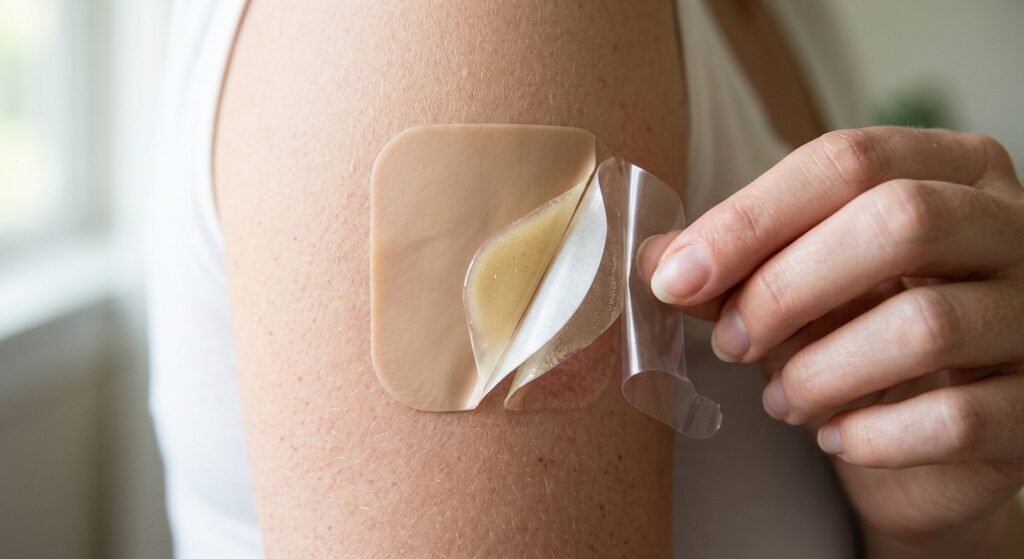
Why Layer Design Matters in Transdermal Delivery
Transdermal delivery involves moving an active pharmaceutical ingredient across the skin. The outermost skin layer, known as the stratum corneum, creates a significant barrier to drug transport. Consequently, the patch must be engineered to provide an appropriate concentration gradient and contact with the skin while maintaining the stability of the formulation.
The architecture of a transdermal patch determines how the drug moves from its formulation to the skin. A reservoir design may use a membrane to control the rate of drug diffusion. A matrix system can distribute the drug throughout a polymeric layer, while a drug-in-adhesive system places the active ingredient directly into the adhesive.
Because every layer can affect the others, changing one component can alter the performance of the entire system.
The Backing Layer: Protection and Structural Support
The backing layer is the outermost component of most transdermal patches. Its primary purpose is to protect the drug-containing portion of the system from the surrounding environment while providing mechanical support.
Backing materials may include polyester, polyethylene, polyurethane, polyolefin, aluminum-containing laminates, and other films selected according to the formulation and intended use. The backing needs sufficient flexibility to conform to normal skin movement without compromising the integrity of the patch.
Material selection can affect several performance characteristics:
- Protection against moisture and environmental exposure
- Resistance to drug or excipient migration
- Flexibility during movement
- Mechanical strength
- Appearance and thickness
- Compatibility with the underlying formulation
An impermeable or appropriately resistant backing can help prevent the drug from escaping through the outer surface rather than moving toward the skin. It can also help protect the formulation from external moisture and other environmental factors.
For manufacturers, backing selection is therefore more than a cosmetic decision. The material must work chemically and mechanically with the other components of the patch.
The Drug Reservoir or Matrix: Where Formulation Meets Delivery
The drug-containing portion is at the heart of a transdermal delivery system. Depending on the design, the active ingredient can be stored in a separate reservoir, distributed through a polymer matrix, or incorporated into the adhesive.
Traditional reservoir systems contain the drug in a liquid, gel, or suspension. A membrane can then regulate how quickly the formulation reaches the skin. FDA documentation describing reservoir systems identifies the backing, drug reservoir, semipermeable membrane, contact adhesive, and release liner as functional components.
Matrix systems take a different approach. The active ingredient is incorporated into a polymer matrix, creating a thinner construction in many cases. Drug-in-adhesive systems go further by incorporating the active ingredient directly into the adhesive layer.
The formulation needs to maintain the desired physical and chemical properties throughout its shelf life and wear period. Factors such as drug solubility, polymer selection, concentration, excipients, and layer thickness can influence release.
The drug-containing layer can therefore determine not only how much drug is loaded into the patch but also how consistently that drug becomes available for skin permeation.
The Rate-Control Membrane: Managing Drug Release
Not every patch contains a separate rate-control membrane, but when present, this layer can play a critical role in regulating delivery.
In a reservoir system, the membrane is positioned between the drug reservoir and the adhesive or skin-facing portion of the patch. Its permeability and physical characteristics can influence the movement of the active ingredient.
Membrane selection requires consideration of:
- Drug diffusion characteristics
- Membrane permeability
- Thickness
- Polymer composition
- Compatibility with the formulation
- Desired release profile
A membrane that is too restrictive may reduce drug availability, while a membrane that permits excessive transport may produce an undesired release profile. The membrane therefore needs to be evaluated as part of the complete patch rather than as an isolated component.
The Adhesive Layer: Keeping the Patch in Place
Adhesion is essential because the patch needs consistent contact with the skin throughout its intended wear period. A patch that lifts, wrinkles, or detaches can create inconsistent contact and potentially affect delivery.
Pressure-sensitive adhesives are commonly used in transdermal systems. They need to balance initial tack, long-term holding power, removability, and skin compatibility. Research describes tack, peel adhesion, and shear as important adhesive performance characteristics.
The ideal adhesive should:
- Establish adequate contact with the skin
- Remain attached during normal movement
- Resist environmental conditions
- Avoid excessive irritation or sensitization
- Permit removal without unacceptable residue
- Maintain compatibility with the active ingredient and excipients
Adhesive chemistry can also influence drug release. In drug-in-adhesive systems, the adhesive is not simply a bonding agent. It is part of the drug delivery structure itself.
This makes adhesive selection particularly important during transdermal patch development.
The Release Liner: Protection Before Application
The release liner is the removable layer covering the skin-facing side of the patch before use. Its job is to protect the adhesive or drug-containing surface during storage and handling.
Immediately before application, the liner is peeled away to expose the adhesive.
The liner must perform two seemingly opposite functions. It must remain attached strongly enough to protect the patch during manufacturing, packaging, shipping, and handling, but it must also release cleanly when the patient removes it.
Common liner materials include polyester and coated paper or polymer films. The coating can be selected to provide the required release characteristics.
If the liner releases too easily, the patch could become damaged or contaminated during handling. If it releases with excessive force, the user may have difficulty applying the patch correctly or could disturb the adhesive layer.
Therefore, liner release force is an important consideration in overall product usability.
How the Layers Work Together
The performance of a transdermal patch cannot be understood by looking at individual materials alone. The layers form an integrated system.
For example, changing the backing may affect moisture transmission or flexibility. Changing the adhesive can alter both skin adhesion and drug partitioning. Increasing the thickness of a drug-containing matrix may affect diffusion time. Changing the release liner coating can influence how the adhesive behaves during removal.
This interconnected nature means development teams typically evaluate the complete laminate and formulation rather than selecting each material independently.
In addition to laboratory evaluation, manufacturers need to consider physical integrity, chemical stability, drug release, skin permeation, adhesion, liner removal, and residual drug. FDA guidance specifically addresses residual drug in transdermal systems as part of product design, manufacturing, and lifecycle management.
Design Choices That Affect Wear Performance
Patient wear experience is influenced by more than adhesive strength. A patch that remains attached but feels uncomfortable may still present a usability problem.
Important design considerations include patch thickness, flexibility, surface area, adhesive properties, backing material, and the ability of the system to conform to moving skin.
A thinner matrix or drug-in-adhesive design may offer advantages in flexibility and conformability. Research has noted that drug-in-adhesive systems can be thinner and more flexible than reservoir systems, potentially improving conformability and adherence.
However, thinner does not automatically mean better. The formulation must still provide sufficient drug loading, stability, release characteristics, adhesion, and manufacturing robustness.
The optimal design is therefore determined by the requirements of the specific product.
Manufacturing Considerations for Transdermal Patch Development
Once the formulation and layer architecture are established, manufacturing becomes another important part of performance. Coating thickness, drying conditions, lamination, die cutting, alignment, packaging, and storage can all affect the final product.
Consistency is especially important for drug-containing layers. Small variations in coat weight or thickness can potentially affect drug content and delivery characteristics.
Manufacturers may also evaluate adhesive tack, peel, shear, liner release, drug release, permeation, mechanical integrity, and stability.
For companies developing medical and pharmaceutical delivery systems, working with an experienced development and manufacturing partner can help integrate formulation development with material selection and production requirements. R & D Medical Products is an example of the type of specialized expertise that can be relevant when evaluating medical product materials, formulations, and manufacturing considerations.
Choosing the Right Architecture
There is no single layer configuration suitable for every transdermal product. A reservoir system may be appropriate when a controlled membrane is needed. A matrix system can provide a simpler layered structure, while a drug-in-adhesive system can produce a compact patch with the active ingredient integrated into the adhesive.
The choice depends on the active ingredient, required dose, desired release profile, skin permeability, intended wear time, adhesive requirements, stability considerations, and manufacturing capabilities.
Development teams should evaluate these factors together rather than optimizing one property at the expense of the others.
Testing the Finished Patch
Testing is essential for determining whether the selected layer combination delivers the intended performance. Laboratory assessments may examine drug release, skin permeation, adhesive performance, liner removal, physical integrity, and stability.
Adhesive testing can include tack, peel, and shear assessments. Drug release testing can help characterize how the active ingredient becomes available from the patch over time. In vitro permeation studies can provide information about transport through skin models.
These tests help identify whether a design is suitable for further development and whether changes in materials or processing could affect product performance.
Conclusion
The performance of a transdermal patch is the result of carefully coordinated layers rather than one individual material. The backing protects and supports the system, the drug reservoir or matrix stores and controls the active ingredient, a membrane may regulate diffusion, the adhesive maintains skin contact, and the release liner protects the patch until application.
The most effective design approach considers these layers as an integrated system. Material compatibility, drug stability, release characteristics, adhesion, flexibility, manufacturability, and patient usability all need to work together.
For developers and manufacturers, understanding these relationships provides a foundation for creating patches that are reliable, consistent, and suitable for their intended application. Whether the final product uses a reservoir, matrix, or drug-in-adhesive architecture, thoughtful layer selection remains central to successful transdermal delivery.
Frequently Asked Questions
What are the main layers of a transdermal patch?
Common components include a backing layer, drug-containing layer or reservoir, adhesive, and release liner. Some designs also include a separate rate-controlling membrane. The exact configuration depends on the delivery technology.
What does the backing layer do?
The backing layer protects the internal formulation from the external environment and provides structural support. It is generally selected for its flexibility, barrier properties, strength, and compatibility with the formulation.
What is the difference between a reservoir and matrix patch?
A reservoir patch contains the drug in a separate compartment, often with a membrane controlling release. A matrix patch distributes the active ingredient through a polymer matrix. Drug-in-adhesive systems incorporate the drug directly into the adhesive layer.
Why is adhesive selection important?
The adhesive must maintain sufficient contact with the skin throughout the intended wear period while remaining compatible with the formulation and skin. Tack, peel, shear, irritation, residue, and removability are important considerations.
What is the purpose of the release liner?
The release liner protects the adhesive or skin-facing surface during storage and handling. It is removed immediately before the patch is applied.
Can the layers affect drug release?
Yes. The composition and thickness of the drug-containing layer, adhesive, membrane, and other components can influence diffusion and drug availability. The overall architecture needs to be evaluated as a complete delivery system.
How is transdermal patch performance evaluated?
Testing may include drug release, permeation, adhesion, liner removal, physical integrity, stability, and residual drug assessments. Different tests provide information about different aspects of product performance.