

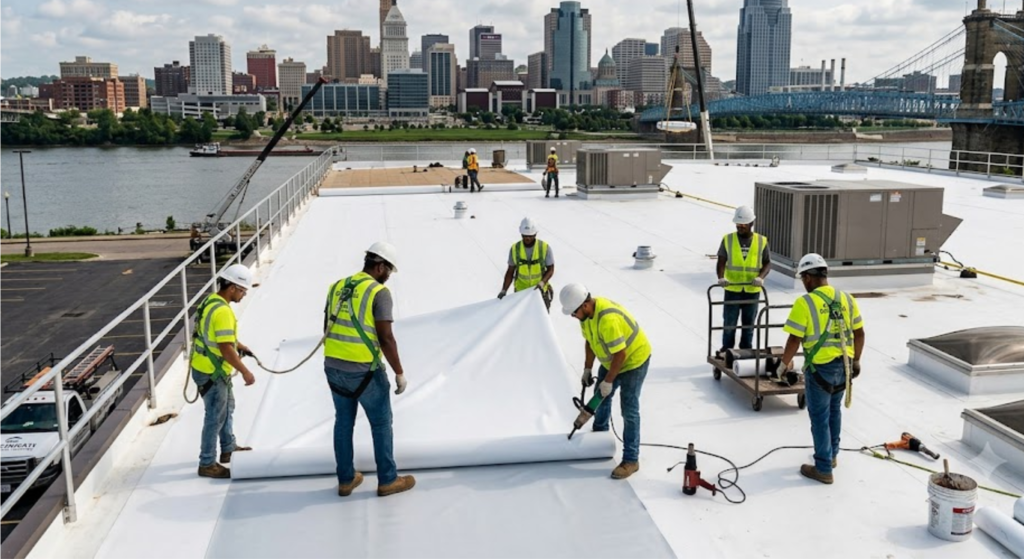
As a commercial property owner or facility manager in Greater Cincinnati, your building’s roof is your primary defense against unpredictable Midwest weather. From harsh freeze-thaw cycles in winter to heavy rainstorms and extreme UV radiation in summer, local climate conditions put continuous stress on commercial flat and low-slope roofing membranes.
Because commercial roofing systems rarely show immediate leaks directly above the point of entry, subtle damage can linger for months before becoming obvious. Delaying necessary repairs can turn a simple seam fix into a costly emergency restoration, complete with ruined inventory, operational downtime, and compromised building safety.
Recognizing early warning signs gives you the leverage to take action before minor defects escalate. Whether you’re budgeting for repairs or planning a full replacement, commercial roofing Cincinnati offers clear guidance and honest pricing.
Here are the top signs that your commercial facility requires professional roof evaluation, maintenance, or replacement.
1. Interior Ceiling Stains, Wall Water Marks, and Mold Growth
The most immediate sign of a compromised commercial roof shows up inside your building. Water intrusion rarely travels straight down; it frequently moves along metal decking, insulation gaps, and utility conduits before dripping onto interior surfaces.
[ Subsurface Membrane Leak ] ──► [ Trapped in Insulation ] ──► [ Travels Decking ] ──► [ Ceiling & Wall Stains ]
Watch out for these interior indicators:
- Yellowish or Brown Ceiling Stains: Water pooling above drop-ceiling tiles signals an active leak in the roof membrane overhead.
- Musty Odors and Mold: Wet insulation inside wall cavities creates an ideal breeding ground for commercial mold and mildew.
- Peeling Drywall and Paint: Water trickling down perimeter walls damages interior finishes, drywall, and structural framing.
Facility Tip: If water spots appear after a heavy rainstorm, mark the outer edge of the stain on the ceiling immediately. This helps your roofing contractor trace the path of water intrusion back to its roof origin.
2. Visible Membrane Damage: Blistering, Cracking, and Open Seams
Modern commercial flat roofs rely on single-ply elastomeric membranes such as TPO (Thermoplastic Polyolefin), EPDM (synthetic rubber), or PVC. Over time, thermal expansion, constant solar exposure, and foot traffic from HVAC service technicians degrade these surface materials.
Key physical defects to watch for during routine inspections include:
- Blistering and Bubbling: Trapped moisture beneath the membrane expands during warm weather, creating raised pockets or “blisters” that weaken the substrate.
- Open or Delaminated Seams: Single-ply seams heat-welded or taped together can pull apart over years of expansion cycles, creating open channels for rainwater.
- Punctures and Tears: Falling branches, sharp windblown debris, or dropped tools during equipment maintenance can easily puncture the outer membrane layer.
3. Persistent Standing or Ponding Water
Flat roofs are engineered with subtle slopes and drainage pathways that lead rainwater toward scuppers, internal drains, and gutters. When water remains standing on a flat roof surface for more than 48 hours after precipitation ends, it is officially classified as ponding water.
┌─────────────────────────────────────────────────────────────────────────────┐
│                      DANGERS OF PONDING WATER ON FLAT ROOFS                 │
├──────────────────────────────┬──────────────────────────────────────────────┤
│ Risk Factor                  │ Operational Consequence                      │
├──────────────────────────────┼──────────────────────────────────────────────┤
│ **Structural Weight Load**   │ Standing water weighs ~8.34 lbs per gallon;  │
│                              │ ponding puts excess stress on roof joists.   │
├──────────────────────────────┼──────────────────────────────────────────────┤
│ **UV Lens Effect**           │ Standing water magnifies sunlight, burning   │
│                              │ and rapidly aging single-ply membranes.      │
├──────────────────────────────┼──────────────────────────────────────────────┤
│ **Seam Breakdown**           │ Prolonged immersion softens adhesives and     │
│                              │ leads to microscopic subsurface leaks.       │
└──────────────────────────────┴──────────────────────────────────────────────┘
If your roof drains are completely free of debris but water continues to collect in specific areas, the underlying insulation boards may have compressed or saturated, requiring professional slope restoration.
4. Spiking Commercial Heating and Cooling Costs
Your commercial roof does more than block rain; it functions as a critical thermal barrier for your entire building. Rigid insulation boards (such as polyisocyanurate) installed beneath single-ply membranes trap conditioned air inside and block external heat transfer.
When a roof membrane develops hidden micro-tears, moisture penetrates and saturates the rigid insulation underneath. Wet insulation loses its R-value (thermal resistance). Consequently, your HVAC system must work significantly harder to maintain interior temperatures during hot Cincinnati summers or freezing winter cold snaps, causing monthly utility bills to surge.
5. Failing Flashings, Coping Caps, and Roof Edge Details
The majority of commercial roof leaks do not start in the middle of a flat membrane field; they occur along wall terminations, parapets, skylights, and mechanical equipment curbs. Metal flashing and perimeter coping caps seal these high-vulnerability transition zones.
Inspect these areas for common failure signs:
- Rusted or Corroded Metal: Unprotected metal flashings deteriorate when exposed to moisture.
- Loose Coping Caps: High winds can lift perimeter metal, exposing wall cavities to wind-driven rain.
- Cracked Sealants: Dried out, cracked caulk around HVAC pipe penetrations allows water to trickle straight into the structural framework.
Summary: Commercial Roof Damage vs. Recommended Actions
| Observed Symptom | Severity Level | Recommended Action |
| Clogged roof drains or surface debris | Low | Perform routine clearing and drain maintenance. |
| Ponding water lasting over 48 hours | Moderate | Schedule a professional drain and slope evaluation. |
| Cracked seam welds or membrane punctures | High | Apply professional single-ply membrane patch repairs. |
| Saturated insulation & widespread ceiling leaks | Critical | Conduct a moisture audit to plan section recovery or full replacement. |
Why Choose Apply Rite Roofing for Commercial Roofing in Cincinnati?
When your building exhibits warning signs, partnering with an experienced local contractor ensures your asset is protected correctly.
At Apply Rite Roofing, we bring two decades of dedicated service to commercial property owners across Greater Cincinnati, Northern Kentucky, and Dayton. Whether your facility features TPO, EPDM, PVC single-ply membranes, or standing seam metal roofing, our team delivers custom solutions designed for long-term weather durability and peak energy efficiency.
[ Diagnostic Inspection ] ──► [ Detailed Assessment Report ] ──► [ Tailored Repair or Replacement ]
Our comprehensive commercial capabilities include:
- Diagnostic Inspections & Maintenance: Identifying hidden leaks before recommending a full tear-off.
- Single-Ply Membrane Installations: High-performance TPO, EPDM, and PVC roof installations.
- Complete Exterior Solutions: Seamless gutters, metal fascia, vinyl siding, and interior drywall/ceiling remodeling after water damage.
Conclusion
Ignoring subtle roof warnings can lead to structural damage, inventory loss, and operational downtime. By conducting regular inspections—especially after severe weather—and remaining alert to ceiling stains, ponding water, open seams, and rising utility bills, you can safeguard your commercial investment.
Don’t wait for a minor leak to turn into an expensive emergency. Trust the experienced team at Apply Rite Roofing to restore your commercial roof with transparent pricing and top-quality craftsmanship. Contact our Cincinnati office today at (513) 241-7483 to schedule your consultation.
Frequently Asked Questions (FAQ)
Q: How often should a commercial roof in Cincinnati be inspected?
A: Commercial roofs should be professionally inspected at least twice a year once in the spring following winter freeze-thaw cycles and once in the autumn before severe winter weather arrives. Additional inspections should take place after major wind or hail storms.
Q: Can a leaking commercial flat roof be repaired without replacing the entire system?
A: Yes. If non-destructive moisture testing reveals that the underlying roof deck and insulation remain dry, individual membrane seams, punctures, or flashings can be repaired at a fraction of full replacement costs.
Q: What is the typical lifespan of a commercial TPO or EPDM flat roof?
A: When properly installed and maintained by certified contractors, modern single-ply TPO and EPDM commercial roofs typically last between 20 to 30 years.