

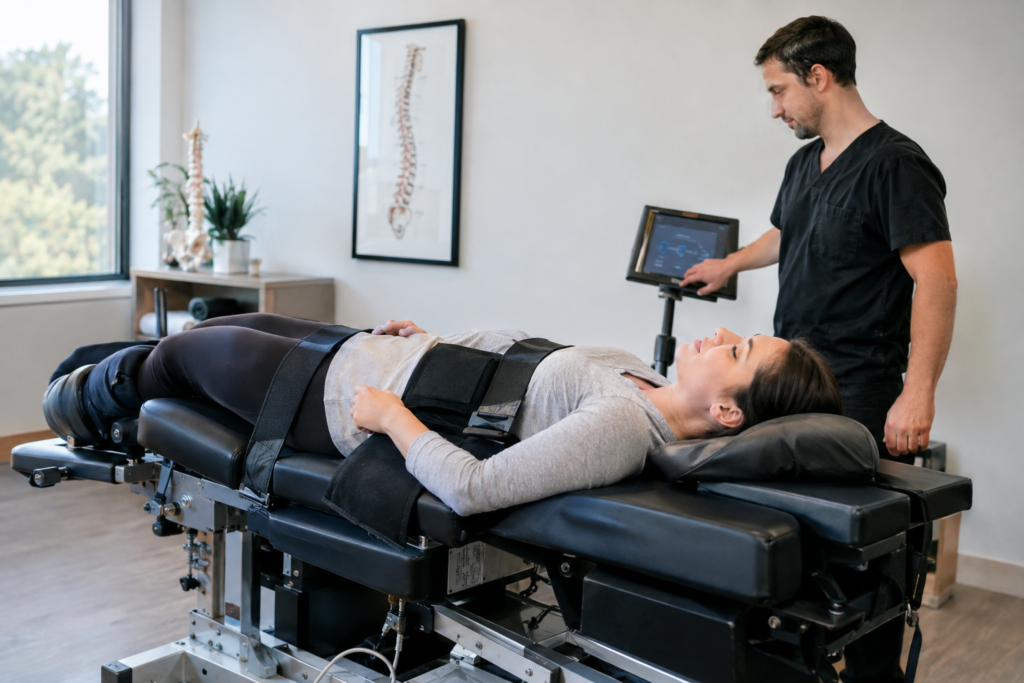
What Is Non-Surgical Spinal Decompression?
Non-surgical spinal decompression uses a specialized table to create controlled changes in the loading of the spine. Depending on the equipment and treatment approach, the patient may lie comfortably on the table while the system applies intermittent or sustained distraction.
The goal is generally to reduce mechanical stress and provide a controlled environment for movement and rehabilitation. Some clinics use decompression as part of a broader care plan that may also include exercise, manual therapy, mobility work, or other conservative approaches.
Searching for spinal decompression naples fl may bring up a variety of treatment options, so it is important to understand that the term does not automatically mean the same protocol is used at every practice.
A qualified Chiropractor Naples patients choose should first determine whether the person’s symptoms are consistent with a condition that may reasonably respond to conservative care.
Who May Be Considered for Spinal Decompression?
Spinal decompression may be considered for certain people experiencing persistent musculoskeletal symptoms, particularly when a clinician believes mechanical loading of the spine may be contributing to the problem.
People With Certain Disc-Related Symptoms
Some patients seek decompression after being told they have a bulging or herniated disc. Disc-related problems can sometimes produce localized back or neck pain, while others may experience symptoms that travel into an arm or leg.
However, having a disc abnormality on an MRI does not automatically mean decompression is appropriate. Imaging findings need to be interpreted alongside symptoms, physical examination findings, medical history, and functional limitations.
People With Radiating Leg Symptoms
Sciatica-like symptoms can involve pain, tingling, numbness, or other sensations extending from the lower back into the buttock or leg.
Because radiating symptoms can have multiple causes, an examination is important before selecting a treatment. Persistent or progressive neurological symptoms require particular attention.
A search for spinal decompression naples fl should therefore be viewed as the beginning of the research process rather than proof that decompression is the right treatment.
People Looking for a Non-Surgical Approach
Some individuals prefer to explore conservative care before considering invasive procedures when their condition does not require urgent medical intervention.
That does not mean non-surgical treatment should replace appropriate medical care. Instead, decompression may sometimes be considered as one component of a broader conservative strategy.
Who May Not Be a Good Candidate?
One of the most important parts of discussing spinal decompression is recognizing that it is not suitable for every type of back or neck problem.
People With Serious or Progressive Neurological Symptoms
Symptoms such as significant or worsening weakness, substantial loss of sensation, or changes involving bowel or bladder control can indicate a potentially serious neurological problem.
These symptoms should not simply be treated with a routine decompression session. They warrant prompt medical assessment. Clinical guidelines emphasize additional evaluation and diagnostic testing when severe or progressive neurological deficits are present or when a serious underlying condition is suspected.
People With Certain Serious Underlying Conditions
Back pain can occasionally be associated with conditions that require medical management rather than conservative mechanical treatment.
Examples can include serious infection, certain fractures, significant spinal instability, or other structural or systemic conditions. The appropriate response depends on the individual’s diagnosis and medical history.
A practitioner should therefore screen for potential contraindications rather than automatically placing every person with back pain on a decompression table.
People Expecting a Guaranteed Cure
Spinal decompression should not be presented as a guaranteed solution for back pain.
Research on traction-based treatment has found limited or uncertain benefits for many forms of low back pain. A Cochrane review found that traction produced little or no meaningful difference in pain, function, global improvement, or return to work across mixed groups of people with low back pain, with or without sciatica.
More recent guidelines have also recommended against routine traction for chronic primary low back pain.
This is why an individualized evaluation matters more than simply choosing a treatment based on its name.
Why an Examination Matters Before Treatment
A proper examination can help determine what may be contributing to a patient’s symptoms and whether conservative care is reasonable.
The evaluation may involve questions about when the symptoms started, whether pain travels into the arms or legs, previous injuries, aggravating activities, medical history, and changes in strength or sensation.
A physical examination may also assess movement, reflexes, strength, sensation, and other relevant findings.
Imaging is not necessarily required for every person with back pain. Clinical guidelines generally recommend diagnostic imaging when serious underlying conditions are suspected or when significant or progressive neurological problems are present.
This distinction is important because an MRI can show abnormalities that may not actually be responsible for someone’s symptoms.
What Should a Decompression Treatment Plan Include?
If a practitioner determines that decompression is reasonable, the treatment should ideally fit into a broader plan rather than operate in isolation.
Depending on the patient’s presentation, conservative care may involve:
- Therapeutic exercise
- Mobility and flexibility work
- Strengthening
- Postural and movement education
- Manual therapy
- Activity modification
- Home exercises
- Follow-up assessments
Exercise is particularly important in modern approaches to chronic low back pain. The WHO guideline states that structured exercise therapy or programs may be offered as part of care for adults with chronic primary low back pain.
The objective should be to improve function and help the patient return to meaningful activities, rather than simply completing a predetermined number of machine-based sessions.
Questions to Ask Before Choosing Spinal Decompression
If you are researching spinal decompression naples fl, consider asking a provider several practical questions before starting.
First, ask what they believe is causing your symptoms and how they reached that conclusion.
Second, ask whether decompression is being recommended as a stand-alone treatment or as part of a broader rehabilitation program.
Third, ask what measurable changes will be used to determine whether treatment is helping.
It is also reasonable to ask what symptoms would cause treatment to be stopped or prompt referral to another healthcare professional.
Finally, ask about alternatives. A trustworthy treatment discussion should include reasonable options rather than assuming that one modality is appropriate for everyone.
Spinal Decompression Is Not the Same as Surgery
The word “decompression” can sometimes create confusion because surgical spinal decompression and non-surgical decompression are very different.
Surgical decompression involves an operation intended to address specific structural problems. Non-surgical decompression is a conservative treatment approach involving mechanical distraction or traction.
Patients should make sure they understand which type of treatment is being discussed and what evidence supports it.
Non-surgical decompression should not be promoted as a replacement for surgery when a serious condition requires surgical evaluation.
What Can Patients Expect From a Responsible Approach?
A responsible approach begins with realistic expectations.
Some patients may report improvement with conservative care, while others may experience little or no change. Treatment response can depend on the underlying condition, symptom duration, activity level, overall health, and several other factors.
The goal should be to determine whether the treatment is helping the individual patient rather than assuming that improvement is guaranteed.
For people considering spinal decompression naples fl, the most useful question is not simply, “Does spinal decompression work?” A more appropriate question is, “Does this treatment make sense for my specific symptoms and diagnosis?”
That distinction can help patients make more informed healthcare decisions.
The Bottom Line
Non-surgical spinal decompression may be considered by some people with persistent back or neck complaints, particularly when disc-related or mechanical symptoms are part of the clinical picture. However, it is not appropriate for every patient, and current evidence does not support using traction routinely for chronic primary low back pain.
People with progressive neurological symptoms, serious underlying conditions, or other potential red flags may require a different form of evaluation and treatment.
Anyone researching spinal decompression naples fl should therefore focus on the quality of the evaluation, realistic expectations, and the overall treatment plan rather than the treatment name alone.
A careful examination can help determine whether decompression belongs in a patient’s conservative care plan or whether another approach would be more appropriate.
Frequently Asked Questions
Is spinal decompression the same as spinal surgery?
No. Non-surgical spinal decompression is a conservative treatment involving controlled mechanical distraction. Surgical decompression is an invasive procedure performed to address specific structural problems.
Can spinal decompression help sciatica?
Sciatica has multiple possible causes, so the appropriate treatment depends on the underlying problem. Some clinics use decompression for sciatica-like symptoms, but research on traction for low back pain with or without sciatica has found limited overall benefit.
Is spinal decompression appropriate for everyone with back pain?
No. A person’s symptoms, medical history, physical examination, and potential red flags should be considered before treatment.
How long does spinal decompression take to work?
There is no universal timeline. Response varies between individuals and depends on the condition being treated and the overall care plan. A provider should establish reasonable goals and reassess progress rather than promising a specific outcome.
Do I need an MRI before spinal decompression?
Not necessarily. Imaging is not routinely required for uncomplicated low back pain. Guidelines generally recommend imaging when serious underlying conditions or significant neurological problems are suspected, or when the results would affect management.
What should I look for when choosing a provider?
Look for a provider who performs an appropriate evaluation, discusses alternatives, explains potential risks and benefits, establishes measurable treatment goals, and recognizes when referral or additional medical assessment is necessary.
Is spinal decompression evidence-based?
The evidence is mixed. Systematic reviews and clinical guidelines have found limited or uncertain benefits for traction in many low back pain populations, and the WHO recommends against routine traction for chronic primary low back pain.