

What Is a Transdermal Patch?
When asking what is a transdermal patch, it helps to understand that the product is more than an adhesive sticker containing medication. It is a delivery system engineered to transport an active pharmaceutical ingredient through the skin.
The skin provides a natural protective barrier. Its outermost layer, known as the stratum corneum, helps prevent substances from entering the body. A transdermal patch must therefore be designed to overcome this barrier while maintaining an appropriate and predictable release rate.
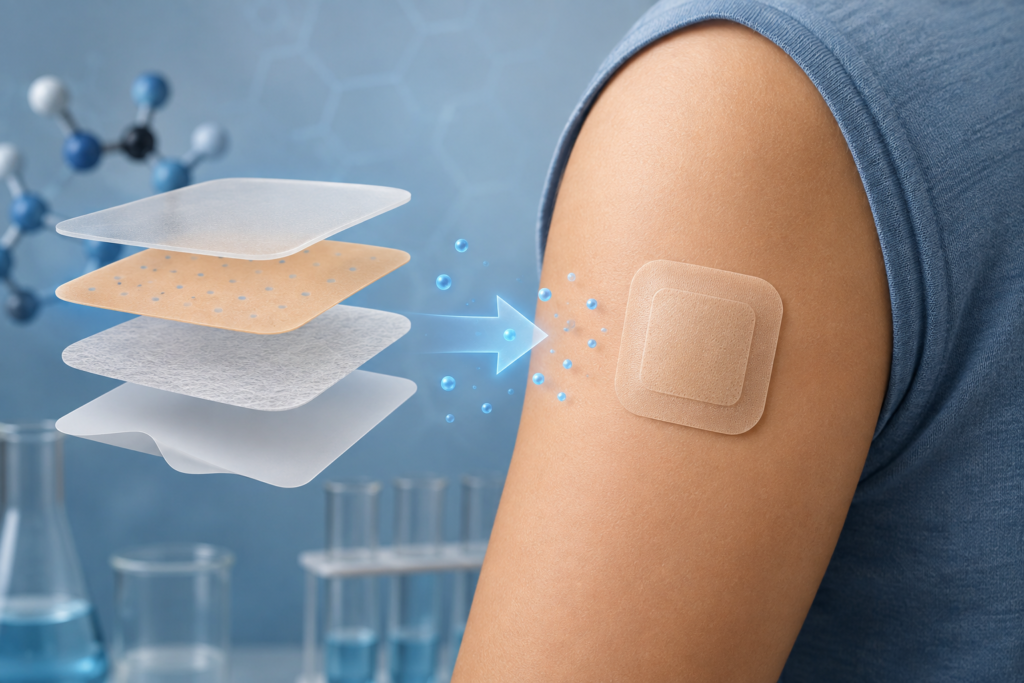
A typical patch may include several components, such as:
- A backing layer that protects the patch from the external environment
- A drug-containing formulation or matrix
- An adhesive layer
- A release liner that protects the adhesive before application
- Other functional components that help control drug release
The exact construction depends on the active ingredient, intended application, desired release profile, and manufacturing requirements.
How Does a Transdermal Patch Work?
Understanding what is a transdermal patch also requires looking at how it delivers an active ingredient.
After the patch is placed on clean, intact skin, the active ingredient begins moving from the patch into the skin. Depending on the design, the ingredient may gradually pass through the skin layers and enter systemic circulation.
The process can generally be described in several stages:
- Patch application: The user places the patch on an appropriate area of skin.
- Drug release: The active ingredient begins leaving the formulation inside the patch.
- Skin penetration: The ingredient moves through the outer layers of the skin.
- Absorption: The ingredient may enter the bloodstream and circulate throughout the body.
- Continued delivery: The patch continues releasing the ingredient according to its engineered release profile.
The rate of delivery can depend on factors such as the formulation, patch design, drug concentration, skin condition, temperature, and properties of the active ingredient.
A Controlled Way to Deliver Drugs Through the Skin
One of the defining characteristics of this technology is that it offers A controlled way to deliver drugs through the skin.
Instead of delivering a complete dose all at once, certain transdermal systems are designed to provide gradual delivery over a specified period. This can be useful when a consistent supply of an active ingredient is desired.
Controlled delivery can also help reduce the need for frequent administration in certain applications. Depending on the medication and product design, patches may be formulated for use over several hours or longer periods.
The actual delivery rate must be carefully established during development and validated through appropriate testing. A patch that releases too quickly may not provide the intended therapeutic profile, while one that releases too slowly may fail to deliver an adequate amount of the active ingredient.
What Are the Main Types of Transdermal Patches?
Transdermal patches can be designed using different technologies. The most appropriate design depends on the properties of the active ingredient and the desired performance characteristics.
Drug-in-Adhesive Patches
In a drug-in-adhesive system, the active ingredient is incorporated directly into the adhesive layer. This design can provide a relatively thin patch and may simplify the overall construction.
The formulation must maintain appropriate drug stability while ensuring that the adhesive performs effectively throughout the intended wear period.
Matrix Patches
Matrix systems contain the active ingredient within a polymeric or other matrix material. The drug gradually diffuses from the matrix and moves through the skin.
Matrix designs can be engineered to provide a controlled release profile while maintaining the physical integrity of the patch.
Reservoir Patches
Reservoir systems contain the active ingredient in a separate reservoir. Additional components may help regulate the movement of the drug toward the skin.
Although reservoir technologies can offer precise control, they can involve more complex construction and manufacturing considerations.
Why Are Transdermal Patches Used?
Transdermal delivery can provide several potential advantages compared with some other administration methods.
One major benefit is convenience. A patch can potentially provide extended delivery without requiring repeated oral dosing throughout the day.
Another advantage is that transdermal administration can bypass the gastrointestinal tract. For certain active ingredients, this may be useful because oral administration can be affected by digestion or other factors.
Transdermal systems may also help provide relatively consistent drug delivery when properly designed and used. This can be particularly important for medications where maintaining an appropriate level of the active ingredient is desirable.
However, transdermal delivery is not appropriate for every medication. The active ingredient must have suitable characteristics for crossing the skin, and the formulation must be developed to support reliable delivery.
What Makes an Active Ingredient Suitable for Transdermal Delivery?
A key part of understanding what is a transdermal patch is recognizing that not every drug can simply be placed into a patch.
The skin is a strong barrier, and the active ingredient must have properties that allow it to penetrate that barrier at a useful rate. Factors that can influence suitability include molecular size, solubility, potency, melting point, chemical stability, and skin permeability.
The desired daily dose also matters. Highly potent compounds requiring very small quantities may be more suitable than substances that would require a large amount of material to achieve the intended effect.
Formulation scientists evaluate these properties during development to determine whether transdermal delivery is technically feasible.
The Importance of Formulation Development
Creating an effective patch requires more than selecting an active ingredient. Developers must determine how the ingredient interacts with other components of the system.
For example, formulation development may consider:
- Drug solubility
- Drug stability
- Release characteristics
- Skin permeability
- Adhesive compatibility
- Moisture sensitivity
- Temperature sensitivity
- Shelf-life requirements
- Manufacturing consistency
Specialized organizations such as R & D Medical Products can play an important role in developing and refining advanced medical delivery products by supporting formulation, testing, and manufacturing considerations.
A successful development process focuses on both performance and practical usability. The final patch needs to maintain its physical structure, adhere appropriately, protect the formulation, and deliver the intended amount of active ingredient under specified conditions.
How Are Transdermal Patches Manufactured?
Manufacturing a transdermal patch typically involves multiple carefully controlled processes. Depending on the design, these can include preparing the drug formulation, mixing active ingredients with excipients, coating the formulation onto a substrate, drying or curing the material, laminating layers, cutting individual patches, and packaging the finished product.
Quality control is essential throughout the process.
Manufacturers may evaluate characteristics such as:
- Patch dimensions
- Weight and thickness
- Drug content
- Uniformity
- Adhesive properties
- Release rate
- Stability
- Package integrity
- Microbiological quality where applicable
Production processes must be designed to produce consistent patches from one manufacturing batch to another.
What Factors Can Affect Transdermal Delivery?
Even a carefully engineered patch can be affected by external conditions.
Skin condition is one important factor. Damaged, irritated, or inflamed skin may behave differently from healthy skin. The location where a patch is applied can also influence absorption because skin thickness and characteristics vary across the body.
Temperature may also affect delivery. Increased skin temperature can potentially influence blood flow and the movement of certain substances through the skin.
Other considerations include sweating, physical activity, moisture, patch adhesion, and exposure to external conditions.
For these reasons, transdermal products include specific instructions regarding application, storage, handling, and wear time.
Benefits and Limitations of Transdermal Patches
The advantages of transdermal systems include convenience, potentially extended delivery, avoidance of the gastrointestinal tract, and the ability to provide a controlled release profile.
However, there are limitations as well.
Some active ingredients cannot effectively cross the skin without additional technology. Skin irritation or allergic reactions to the medication or adhesive may occur in some users. Patch performance can also be influenced by environmental and physiological factors.
Transdermal delivery is therefore a specialized drug delivery approach that requires careful product development rather than a universal replacement for oral or injectable medications.
What Is the Future of Transdermal Patch Technology?
Advances in pharmaceutical formulation and materials science continue to expand the possibilities for transdermal delivery.
Researchers are exploring improved adhesives, advanced polymers, penetration-enhancing technologies, microneedle systems, and other approaches that may help deliver compounds that previously presented challenges.
The goal is to improve delivery efficiency while maintaining safety, stability, comfort, and consistent performance.
As development techniques continue to evolve, understanding what is a transdermal patch becomes increasingly relevant for manufacturers, healthcare professionals, researchers, and consumers interested in modern drug delivery technologies.
Choosing the Right Development Partner
Developing a transdermal product involves numerous technical decisions. From early feasibility studies through formulation development, testing, manufacturing, and packaging, each stage can influence the final product.
A knowledgeable development and manufacturing partner can help identify formulation challenges, evaluate delivery requirements, optimize product construction, and establish appropriate quality controls.
Organizations such as R & D Medical Products can support companies working on innovative medical product development and delivery technologies.
Whether a company is investigating a new transdermal formulation or improving an existing product, a structured development process can help ensure that the finished system meets its intended performance requirements.
Final Thoughts
So, what is a transdermal patch? It is a specialized drug delivery system designed to transfer an active ingredient through the skin, often at a controlled rate over a defined period.
While the finished product may look simple, transdermal patches rely on sophisticated formulation science, material selection, adhesive technology, manufacturing controls, and quality testing. Their ability to provide convenient and controlled delivery makes them an important part of modern pharmaceutical and medical product development.
As technology continues to advance, transdermal systems may become even more versatile, creating new opportunities for delivering medications and other active compounds through the skin.
Frequently Asked Questions
What is a transdermal patch used for?
A transdermal patch is used to deliver certain medications or active ingredients through the skin. Depending on the product, it may provide systemic delivery into the bloodstream or support localized effects.
What is a transdermal patch made of?
A transdermal patch may contain a backing layer, active ingredient formulation, adhesive, release liner, and other components designed to control drug release and protect the product.
How long does a transdermal patch work?
The intended wear time varies by product. Some patches are designed for several hours, while others can remain in place for a day or longer. Users should follow the specific instructions provided with the product.
Can all medicines be made into transdermal patches?
No. An active ingredient must have appropriate chemical, physical, and pharmacological characteristics to be suitable for transdermal delivery. Formulation and feasibility studies are necessary before development.
Does a transdermal patch enter the bloodstream?
Some transdermal patches are specifically designed to allow an active ingredient to cross the skin and enter systemic circulation. Others may be intended primarily for localized delivery.
What is the difference between a transdermal patch and a topical patch?
A transdermal patch is generally designed to deliver an active ingredient through the skin and potentially into systemic circulation. A topical product is typically intended to act primarily on the skin or a local area.
Can transdermal patches cause skin irritation?
Some people may experience irritation, redness, itching, or other reactions at the application site. Product instructions should be followed carefully, and persistent or severe reactions should be discussed with a healthcare professional.
Why is formulation important in transdermal patch development?
Formulation determines important characteristics such as drug stability, release rate, skin penetration, compatibility with other materials, and overall product performance. Careful formulation development is essential for producing a reliable transdermal system.