

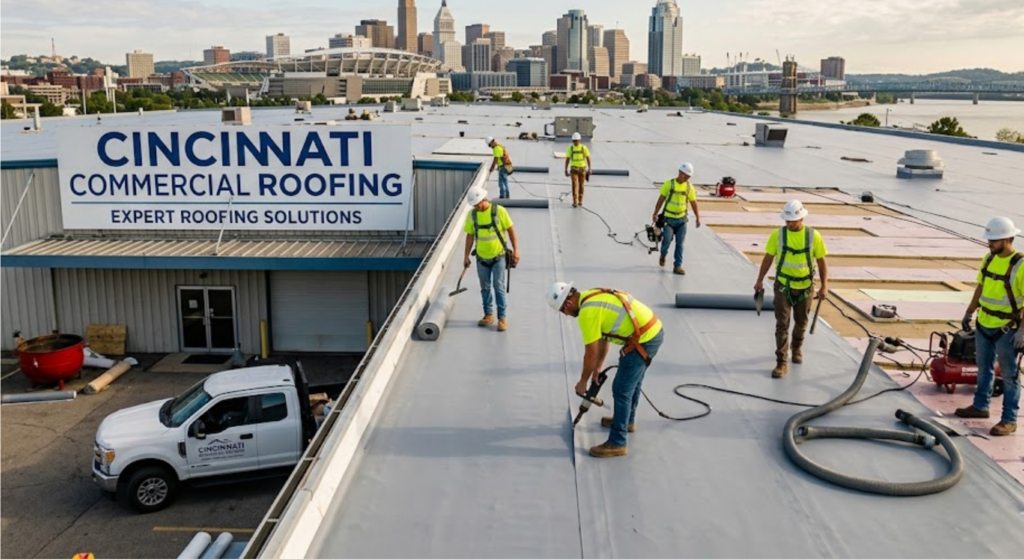
For commercial property owners, facility managers, and industrial directors across the Greater Cincinnati region, keeping an operational facility in peak structural condition is a non-negotiable reality. Among all components protecting your enterprise, none works harder or absorbs more environmental punishment than your roof. It safeguards your inventory, high-value manufacturing machinery, office technology, and most importantly your employees and clients from the volatile elements.
Because commercial structures utilize large, low-slope or flat roofing footprints, structural problems rarely mirror residential ones. You won’t easily spot a missing shingle from your parking lot. Instead, commercial roof degradation happens subtly, hiding beneath single-ply layers or insulation boards until a major system failure disrupts your daily operations. Knowing when to call in a specialized regional professional is key to preserving your facility’s equity. Cincinnati commercial roofing helps reduce downtime and long-term costs with preventative maintenance and durable roofing solutions.
Recognizing the primary warning signs that your asset requires immediate professional attention will shield your business from unexpected capital expenditures, operational halts, and compounding structural damage.
1. Persistent Interior Moisture and Ceilings Staining
The most critical and immediate indicator that your commercial roof is failing is the appearance of water inside your building. While a minor roof leak in a house might show up right below the problem area, water on a flat commercial deck behaves differently. Water can travel hundreds of feet along corrugated metal decks or concrete slabs before finding an unsealed seam or utility penetration to drop through.
Keep a close eye out for these internal warning signs:
- Stained T-Bar Ceiling Tiles: The classic development of unsightly brown or yellow water rings on your acoustic ceiling grid.
- Blistering Drywall or Paint: Pockets of trapped water migrating behind commercial wall coatings, causing bubbling or peeling along wall joints.
- Musty Odors in the Sub-Ceiling: Recurring musty smells or visible mold colonies forming on HVAC registers and perimeter support beams.
If water is actively entering your warehouse, retail floor, or corporate suites, patching the drywall is a temporary fix. You need an advanced commercial inspection to trace the water back to its true point of entry on the roof deck.
2. Failing Seals, Open Seams, and Material Splitting
Modern commercial roof designs are highly dependent on continuous single-ply membranes like Thermoplastic Polyolefin (TPO), Polyvinyl Chloride (PVC), or EPDM rubber. The strength of these materials rests entirely on the integrity of their seams, which are hot-air welded or chemically adhered together.
Over decades of enduring intense summer heat and freezing winter conditions, these seams experience extreme thermal movement. When walking a roof during a routine maintenance sweep, look for signs of seam separation, edge curling, or mechanical splitting. Because a flat roof manages a massive volume of rushing stormwater, even a tiny three-inch opening along a membrane seam can channel hundreds of gallons of water directly into your building insulation during a severe Ohio Valley storm.
[ Major Commercial Roof Defect Indicators ]
      |
      +---> Open Seams & Welds (Water enters the insulation core)
      |
      +---> Blistering Membranes (Trapped moisture vaporizing and expanding)
      |
      +---> Failed Flashings (Cracked seals around HVAC units and pipes)
      |
      +---> Blocked Drainage Networks (Ponding water accumulating weight)
3. Chronically Blocked Drainage Systems and Ponding Water
By civil and architectural engineering standards, a flat commercial roof must shed water completely within 48 hours of a rain event. If your facility has deep standing pools of water long after a storm has passed, your roof is experiencing a condition known as ponding water.
Ponding water introduces severe structural and material hazards:
- Excessive Structural Weight: Water weighs roughly 62.4 pounds per cubic foot. Large standing pools place thousands of pounds of unintended “dead load” stress on your structural steel joists and concrete pillars.
- Accelerated Material Degradation: Standing water acts as a magnifying glass, concentrating UV rays that bake the single-ply membrane and break down standard commercial adhesives.
- Vegetation and Debris Accumulation: Standing water collects dirt, leaves, and organic debris, leading to moss, algae, or weed growth that can physically punch through your roof’s outer layer.
A qualified commercial roofing crew can easily correct these issues by clearing blocked internal drains, installing wider scuppers, or adding custom tapered insulation panels to direct water toward the proper drainage outflows.
4. Skyrocketing Energy Costs due to Saturated Insulation
A commercial roof serves a massive role in your facility’s thermal efficiency envelope. Layers of rigid polyisocyanurate (ISO) insulation boards are installed beneath the membrane to keep indoor temperatures stable, lowering your heating bills in winter and keeping cooling costs down in summer.
If your monthly utility bills have taken a sharp, unexplained jump upward, your roof infrastructure may be to blame. When an unnoticed leak punctures a membrane, the water flows straight down into the underlying insulation boards. Once rigid insulation becomes saturated with water, it permanently loses its R-value (thermal resistance). Your building begins to dump conditioned air straight through the roof, forcing your industrial HVAC units to work overtime. Using sophisticated infrared drone cameras, local commercial specialists can easily spot these cold, wet insulation pockets and extract them before the rot spreads across the entire deck.
Strategic Overview: Preventative Maintenance vs. Reactive Crisis Management
| Operational Characteristic | Proactive Commercial Maintenance Program | Reactive “Fix-It-When-It-Breaks” Approach |
|---|---|---|
| Financial Predictability | Small, planned operational expenses. | Massive, unpredictable capital expenditure hits. |
| Asset Lifespan | Extends TPO/EPDM membranes to their true 25–30 year maximum. | Often forces a full premature roof tear-off by year 12 to 15. |
| Business Downtime | Scheduled during off-hours with zero operational impact. | Sudden, emergency closures due to interior flooding or inventory loss. |
| Warranty Protection | Validates and preserves valuable manufacturer NDL labor/material warranties. | Can void manufacturer warranties due to owner neglect or poor maintenance records. |
Conclusion
Your commercial facility is a major capital asset that deserves expert care. Ignoring the subtle early indicators of roof failure like interior wall stains, splitting single-ply seams, chronic ponding, or rising monthly energy bills is an expensive gamble that can result in unexpected downtime and severe asset degradation. By choosing a dedicated, local commercial roofing partner, you ensure your property receives the specialized engineering, code-compliant handling, and proactive maintenance programs required to thrive. Protect your facility, secure your inventory, and enjoy complete peace of mind by scheduling an advanced commercial roof assessment before a minor repair turns into a major structural emergency.
Frequently Asked Questions (FAQ)
Q: How often should our facility schedule a commercial roof inspection?
A: Industry standard dictates scheduling professional roof inspections at least twice a year. The ideal times are early spring (to assess winter freeze and snow damage) and late fall (to clear debris and prep the drainage network for winter weather).
Q: What is a No-Dollar-Limit (NDL) warranty, and why does it matter?
A: An NDL warranty is a premium manufacturer-backed guarantee that covers the full cost of both materials and specialized labor to fix a covered roof defect, with no financial cap over the life of the warranty. These are exclusively available through certified, highly trained commercial master contractors.
Q: Is it possible to coat our commercial flat roof instead of replacing it entirely?
A: Yes. If a professional core cut test reveals that your roof’s structural deck and underlying insulation layers are completely dry and intact, a liquid-applied silicone or acrylic elastomeric coating can be applied. This restores your roof’s water resistance and reflects solar heat at a fraction of the cost of a full structural tear-off.