

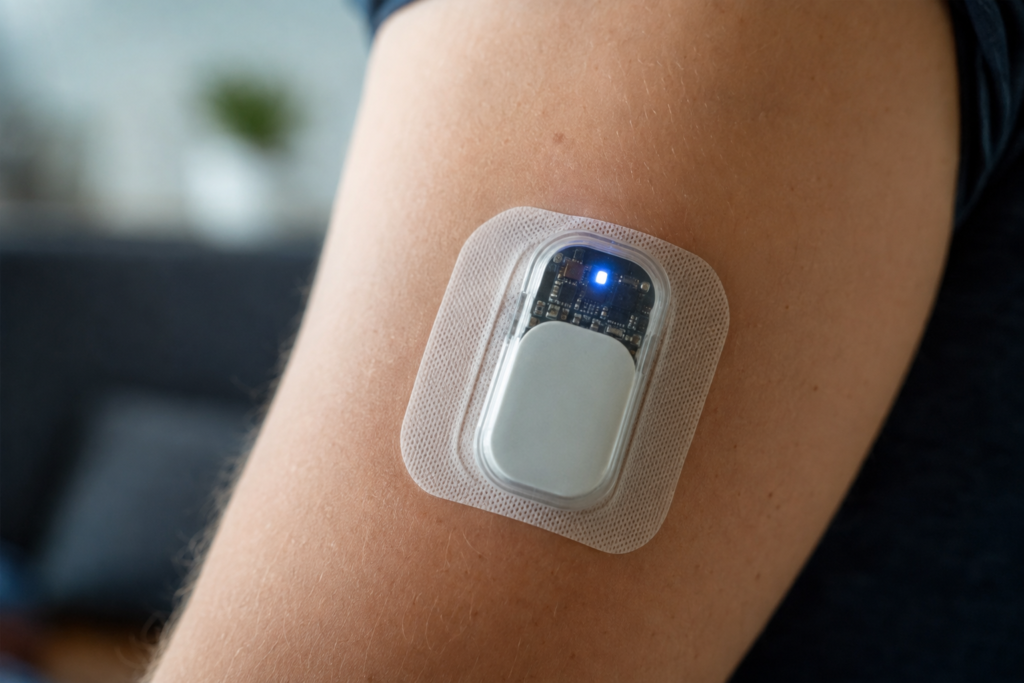
Understanding the Wearable Medical Device Market
Wearable medical devices are designed to be worn directly on or near the body while performing a healthcare-related function. Depending on their intended use, they can monitor physiological measurements, support treatment, deliver electrical stimulation, or transmit patient information to clinicians and other systems.
Common examples include:
- Continuous glucose monitors
- ECG and cardiac monitoring patches
- Wearable pulse and oxygen sensors
- Temperature monitoring patches
- Remote patient monitoring devices
- Rehabilitation sensors
- Wearable drug delivery systems
- Smart medical patches
- Motion and activity monitoring systems
Each product presents different engineering challenges. A device intended for a few hours of monitoring may have very different material and adhesive requirements from a device designed to remain on the skin for several days.
Manufacturers should therefore define the intended use, duration of wear, target patient population, operating environment, and required performance before selecting materials or beginning large-scale production.
Start With the Intended Use
One of the most important decisions in medical device development is defining exactly what the product is intended to do.
A wearable that simply records activity may face different regulatory considerations than a device that provides information used to diagnose or manage a medical condition. The intended use influences design requirements, validation, testing, labeling, clinical evidence, and the regulatory pathway.
This distinction has become increasingly important as wearable technology moves closer to clinical decision-making. Regulators have been paying closer attention to health and fitness products when their features begin making medical claims. At the same time, lower-risk wellness products may receive different treatment when they avoid claims involving diagnosis or treatment.
Manufacturers should establish the intended purpose early rather than attempting to address regulatory requirements after the product has already been designed.
Material Selection Is a Critical Design Decision
Materials affect nearly every aspect of a wearable device. They influence flexibility, comfort, durability, sensor performance, moisture resistance, skin compatibility, and manufacturing efficiency.
A wearable may incorporate materials such as:
- Medical-grade films
- Elastomers
- Flexible printed materials
- Conductive inks
- Foam layers
- Protective membranes
- Medical adhesives
- Flexible substrates
- Encapsulation materials
The material stack must function as an integrated system. A sensor may have excellent electrical characteristics in laboratory testing but perform poorly when exposed to sweat, repeated bending, body movement, or changes in temperature.
Manufacturers should therefore test materials under conditions that resemble actual use rather than relying solely on individual component specifications.
Why Adhesives Matter in Wearable Devices
Adhesive selection is often one of the most underestimated parts of wearable development. The adhesive must hold the product securely while remaining comfortable against the skin.
Flexible adhesives keep sensors on through wear and water.
That requirement becomes especially challenging when users sweat, shower, exercise, sleep, or repeatedly move the body area where the device is attached. An adhesive that works well under dry laboratory conditions may not provide adequate performance during extended wear.
Manufacturers should evaluate factors such as:
- Initial tack
- Long-term adhesion
- Moisture resistance
- Flexibility
- Breathability
- Residue
- Removal characteristics
- Skin irritation potential
- Wear duration
- Compatibility with device materials
Adhesive selection should also account for the location of the device. Skin characteristics vary significantly between the arm, chest, abdomen, wrist, back, and other areas.
Biocompatibility and Skin Contact
Many wearable medical devices are designed to remain in contact with the body for extended periods. That makes biological safety a fundamental consideration.
The FDA evaluates medical devices that directly or indirectly contact the human body for the potential of unacceptable adverse biological responses. Its biocompatibility framework references ISO 10993-1 and emphasizes evaluating biological risks within the broader device development and risk-management process.
Manufacturers should consider every material that could come into contact with the patient, including adhesives, coatings, films, inks, electrodes, housings, and other exposed components.
Biocompatibility planning should begin early because changing a material late in development can affect manufacturing processes, performance testing, packaging, and regulatory documentation.
Sensor Performance and Signal Quality
The purpose of many wearable medical devices is to collect accurate physiological information. Sensor performance therefore needs to remain consistent outside controlled laboratory conditions.
Body movement can create mechanical artifacts. Sweat can change electrical characteristics. Temperature can affect components. Improper adhesion can introduce gaps between a sensor and the skin.
For this reason, manufacturers should test wearable sensors under realistic use conditions.
Testing can include:
- Repeated bending
- Stretching
- Compression
- Moisture exposure
- Temperature changes
- Extended wear
- Repeated attachment and removal where applicable
- Simulated physical activity
- Skin contact testing
The objective is to determine whether the device continues to perform as intended throughout its expected operating life.
Flexible Electronics and Miniaturization
The shift toward smaller and more comfortable wearables has increased interest in flexible electronics. Flexible circuits can help devices conform to curved body surfaces while reducing bulk.
However, miniaturization creates its own challenges. Smaller components can make assembly more demanding, while flexible structures may experience mechanical stresses that traditional rigid electronics do not encounter.
Manufacturers need to evaluate:
- Circuit flexibility
- Component placement
- Electrical connections
- Mechanical strain
- Encapsulation
- Heat generation
- Battery integration
- Wireless communication
- Manufacturing tolerances
A successful wearable design balances electronic performance with the physical realities of being worn on a moving human body.
Manufacturing for Consistency
Prototype development and mass production are very different stages.
A prototype may be assembled manually with considerable attention to each component. Commercial production requires repeatable processes that produce consistent results across thousands or millions of units.
Manufacturers should establish controlled processes for:
- Material receiving
- Component inspection
- Adhesive application
- Sensor placement
- Lamination
- Electronics assembly
- Encapsulation
- Final assembly
- Functional testing
- Packaging
- Traceability
Process validation becomes particularly important when small variations can affect sensor performance or skin adhesion.
Working with an experienced R & D Medical Products partner can help companies evaluate materials, refine prototypes, improve manufacturability, and identify potential problems before production scales.
Testing Should Reflect Real-World Use
Wearable medical devices should be tested in environments that resemble how patients will actually use them.
A device intended for continuous monitoring should not be evaluated only during a short laboratory demonstration. Manufacturers should consider the effects of movement, moisture, temperature, repeated use, and extended skin contact.
Testing programs can incorporate mechanical, electrical, environmental, biological, and functional evaluations.
The exact testing requirements depend on the device’s design and intended use, so manufacturers should establish a risk-based testing strategy that addresses the most important potential failure modes.
Cybersecurity Is Part of Device Design
Many modern wearable medical devices communicate with smartphones, cloud platforms, healthcare networks, or other connected systems. This connectivity creates valuable opportunities for remote monitoring but also introduces cybersecurity responsibilities.
The FDA’s February 2026 cybersecurity guidance provides recommendations concerning device design, quality systems, and information included in premarket submissions for devices with cybersecurity risks.
For applicable connected devices, manufacturers should consider cybersecurity throughout the product lifecycle. Important areas can include:
- Secure communication
- Authentication
- Data protection
- Software updates
- Vulnerability management
- Access controls
- Threat modeling
- Software inventory
- Postmarket monitoring
The FDA also identifies requirements related to cybersecurity plans, vulnerability management, updates, and software bills of materials for qualifying cyber devices.
Cybersecurity should not be treated as an add-on after hardware and software development are complete. It belongs in the initial architecture and risk-management process.
Packaging and Shelf Life
Packaging is another important part of wearable device manufacturing. Medical packaging must protect components from environmental conditions, physical damage, contamination, and other hazards throughout transportation and storage.
Manufacturers should determine how the device reacts to:
- Humidity
- Temperature
- Compression
- Vibration
- Light
- Oxygen
- Long-term storage
For adhesive-based wearable products, packaging can be particularly important because environmental exposure may affect adhesive performance before the product is even opened.
Shelf-life testing should demonstrate that the packaged device continues to meet its specified requirements through the expected storage period.
Quality Systems Support Scalable Production
Quality cannot be added at the end of the manufacturing process. It needs to be incorporated into product development, supplier management, production, testing, packaging, and postmarket activities.
A strong quality system helps manufacturers document processes, identify deviations, manage changes, investigate problems, and maintain traceability.
Supplier qualification is also essential. If a critical adhesive, sensor, film, or electronic component changes unexpectedly, the performance of the final wearable may change as well.
Manufacturers should establish clear specifications and change-control procedures for critical materials and components.
Choosing the Right Development Partner
Developing wearable medical devices often requires expertise across multiple disciplines. A company may have a strong medical concept but lack specialized experience in adhesives, flexible materials, transdermal systems, electronics integration, or manufacturing scale-up.
An experienced product development partner can help bridge these gaps.
R & D Medical Products can be an important resource for manufacturers looking to move from an initial concept toward a practical, manufacturable medical product. Expertise in materials, formulation, prototyping, testing, and production can help reduce development risks and improve the transition from prototype to finished device.
The right partner should understand that wearable development is an integrated process. Adhesives affect sensor placement. Materials affect comfort. Electronics affect packaging. Packaging affects shelf life. Manufacturing affects consistency. Every decision can influence another part of the product.
The Future of Wearable Medical Devices
The future of wearable medical devices is moving toward smaller, smarter, more connected, and more comfortable products.
Continuous monitoring is becoming increasingly important because it can provide healthcare professionals and patients with information over time rather than relying exclusively on occasional measurements. Recent regulatory developments also demonstrate how wearable technology is expanding into increasingly sophisticated monitoring applications.
Future products may combine multiple sensors, advanced analytics, flexible electronics, wireless connectivity, and increasingly personalized monitoring.
For manufacturers, success will depend on more than adding features. The best products will combine reliable measurements with comfort, durability, security, manufacturability, and a clear clinical purpose.
Conclusion
Developing wearable medical devices requires a careful balance between technology, materials, patient comfort, manufacturing, quality, and regulatory expectations. From the initial concept through commercialization, manufacturers must consider how the device will behave on the human body and in real-world conditions.
Adhesives, sensors, flexible substrates, electronics, packaging, cybersecurity, and biocompatibility are not isolated considerations. They work together to determine whether a wearable product is safe, reliable, comfortable, and commercially viable.
By establishing the intended use early, selecting appropriate materials, validating performance under realistic conditions, and working with experienced development and manufacturing partners, companies can create wearable medical devices that are better prepared for both regulatory review and everyday patient use.
Frequently Asked Questions
What are wearable medical devices?
Wearable medical devices are healthcare products designed to be worn on or near the body to monitor physiological information, support treatment, deliver therapy, or perform another defined medical function.
What materials are commonly used in wearable medical devices?
Wearable products may use medical-grade films, flexible substrates, elastomers, conductive materials, adhesives, electrodes, encapsulation materials, and electronic components. Material selection depends on the device’s intended use and contact requirements.
Why are adhesives important for wearable medical devices?
Adhesives help keep sensors and other components securely positioned against the body. They must balance strong attachment with flexibility, comfort, moisture resistance, and skin compatibility.
How does biocompatibility affect wearable device manufacturing?
Any material that contacts the body must be evaluated for potential biological risks appropriate to the device. The FDA’s biocompatibility framework considers the potential for adverse biological responses from device materials.
Are wearable medical devices subject to FDA regulation?
Some are. Regulatory requirements depend on factors including intended use, claims, technology, and risk. Manufacturers should determine the appropriate regulatory pathway during early product development.
What role does R & D Medical Products play in wearable device development?
R & D Medical Products can support areas such as product development, materials evaluation, prototyping, formulation, testing, and manufacturing preparation, helping manufacturers move from an initial concept toward a production-ready product.
Why is cybersecurity important for connected wearable devices?
Connected wearables can collect, transmit, and process health information. Cybersecurity measures help protect the device, its data, and connected systems from potential threats. The FDA recommends addressing cybersecurity throughout the device lifecycle.
What should manufacturers consider before scaling production?
Manufacturers should evaluate material consistency, supplier reliability, assembly processes, quality controls, testing, packaging, traceability, regulatory requirements, and production tolerances before moving from prototypes to commercial manufacturing.