

Tech
- Co-chaired by former Gov. David Beasley (R – South Carolina) and former Sen. Ben Cardin (D – Maryland), Rockefeller and Packard Foundations, along with other partners, launch initiative one year after USAID’s closure.
- Independent Commission gets underway as new polling shows 8 in 10 Americans want aid reformed, not eliminated.
- With Brookings Institution and AEI support, Commissioners (former senior U.S. politicians and executives from across the political spectrum) will spend the next year building a blueprint for a more effective and accountable system of U.S. foreign assistance.
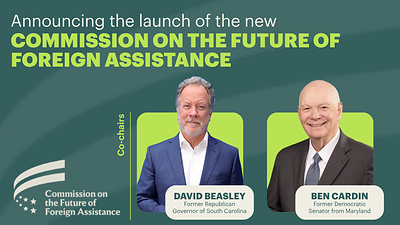
NEW YORK, July 14, 2026 /PRNewswire/ — The Rockefeller Foundation and the David and Lucile Packard Foundation, along with other partners, announced today the launch of the new Commission on the Future of Foreign Assistance to reimagine a more effective, accountable, and widely supported system for delivering U.S. assistance around the world. Co-chaired by former Governor of South Carolina and Executive Director of the United Nations World Food Programme (WFP), the Honorable David Beasley, and the Honorable Ben Cardin, former U.S. Senator from Maryland, the ten-member Commission, composed of former members of Congress and former senior officials from across the political spectrum, is charged with developing a forward-looking blueprint for U.S. foreign assistance that will be released in 2027. The American Enterprise Institute (AEI) and the Brookings Institution will support the independent body’s efforts to identify the reforms needed to strengthen foreign aid as a key pillar of U.S. foreign and national security policy, but also how a new approach could secure the widespread public support and backing needed to sustain its work going forward.
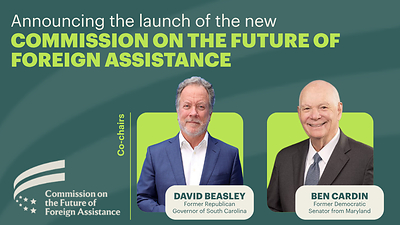
Gov. Beasley said: “From my years leading the World Food Programme, I witnessed some of the most devastating humanitarian crises of our time first-hand and saw how foreign assistance must address both the emergency needs as well as the root causes if we want to protect U.S. interests at home and around the world. Yet, U.S. assistance programs are often skewed towards short term crises rather than building long-term resilience. We now have an opportunity to build a better system – and we must take it.”
Sen. Cardin said: “As chairman of the Senate Foreign Relations Committee, I witnessed the fraying of foreign policy on political grounds. Yet, in order to ensure that U.S. foreign assistance is a predictable and reliable tool to make us safer, stronger, and more prosperous, we need to restore a bipartisan approach that can be explained to the American people in a persuasive way. Having introduced legislation with then Senator Rubio to make foreign aid more transparent and accountable, I am excited to serve on this bipartisan Commission and look forward to beginning our work.”
One year ago, the U.S. Agency for International Development (USAID) was shuttered, one part of the steepest single-year cut to global aid on record. According to the Organisation for Economic Co-operation and Development (OECD), total official development assistance (ODA) fell 23.1% in 2025, from $215.1 billion to $174.3 billion — a decline of roughly $40 billion and the largest annual contraction ever recorded. These cuts will have a real human toll given their impact on life-saving programs that were curtailed or terminated.
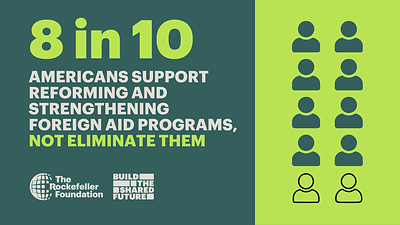
At the same time, a recent survey — An American Perspective on Foreign Aid — by Echelon Insights, commissioned by The Rockefeller Foundation last month, surveyed more than 2,000 respondents nationwide across age, education, and political backgrounds, and found that a majority (54%) across the political spectrum remains favorable toward foreign assistance a year after USAID’s dismantlement, and 8 in 10 say the path forward is to reform and strengthen foreign assistance, not eliminate it.
“America’s global leadership was built on the bipartisan belief that helping the world’s most vulnerable is an investment in our own security and prosperity. That’s why decisive majorities of Americans still support international cooperation to fight poverty, hunger, and disease around the world,” said Dr. Rajiv J. Shah, President of The Rockefeller Foundation and former USAID Administrator. “At a time when wealthy countries are pulling back from their commitments to the needy, this Commission is an important step toward building a 21st-century approach that empowers local innovators, delivers value for money, and builds enduring political support.”
“Foreign assistance is an expression of deeply held American values, including compassion, generosity, and shared prosperity, as well as an effective means to serve our national security interests,” said Nancy Lindborg, President and CEO of the Packard Foundation. “Over the decades, these critical investments have saved countless lives, built more resilient communities, and strengthened America’s partnerships around the world. This moment of profound disruption is an opportunity to think boldly about what comes next.”
The Commission on the Future of Foreign Assistance
The ten-member Commission is composed of former members of Congress and former senior officials with decades of experience in U.S. foreign policy and national security. Over the coming months, the Commission will conduct a series of consultations and analysis before offering publicly shared recommendations to reimagine and redesign a U.S. foreign assistance system that can deliver more effectively and garner the public support and political will needed to sustain its work. These suggested reforms will help chart a path for the next chapter of U.S. international engagement and global leadership. In doing so, the Commission aims to illustrate this work in a way that is salient, digestible, and resonant among the citizens who fund it.
Key objectives include:
- Clarifying the scope of foreign assistance that best serves U.S. strategic interests in the world;
- Renewing the purpose of foreign assistance while building a broad-based coalition that aligns government, the private sector, civil society, and the public to direct and implement a new approach to foreign assistance; and
- Proposing a new architecture to deliver foreign assistance more effectively and transparently and to more closely align it with U.S. national and economic security.
The Commissioners have each worked to forge broad reaching policies, even in a time of great political division. The members of the Commission are:
- David Beasley, co-chair of the Commission, former Republican Governor of South Carolina and former Executive Director of the World Food Programme (WFP), who recently joined The Rockefeller Foundation’s Board of Trustees.
- Ben Cardin, co-chair of the Commission, former Democratic Senator from Maryland and former Chairman of the Senate Foreign Relations Committee
- Roy Blunt, former Republican Senator and Member of Congress from Missouri, former Secretary of State of Missouri
- Kay Bailey Hutchison, former Republican Senator and former U.S. Ambassador to NATO
- Ted Yoho, former Republican Member of Congress from Florida
- Henrietta Fore, former Administrator of USAID, former Executive Director of the United Nations Children’s Fund (UNICEF), and former Director of the United States Mint
- Tom Daschle, former Democratic Senator from South Dakota, former Senate Majority Leader, and current chair of the board of the National Democratic Institute (NDI)
- Heidi Heitkamp, former Democratic Senator from North Dakota and former Attorney General of North Dakota
- Daniel Glickman, former U.S. Secretary of Agriculture and Democratic Member of Congress from Kansas
- Alice Albright, former Chief Executive Officer of the Millennium Challenge Corporation (MCC) and former CEO of the Global Partnership for Education
The Rockefeller Foundation and the David and Lucile Packard Foundation worked with other partners to form this Commission and are working to assemble additional partners and support for its important work. To inform its analysis and consultations, the Commission will also draw on research and policy expertise from the American Enterprise Institute and the Brookings Institution across national security, global economics, development, and geopolitics.
“AEI is excited about participating in the Commission on the Future of Foreign Assistance,” said Robert Doar, President of AEI. “For years, Republicans and Democrats alike have been dissatisfied with U.S. foreign assistance. Structures had become unwieldy and dated. Contributions to U.S. foreign policy, economic, and security priorities were difficult to discern, or, at times, were counterproductive. Although the process that brought us to this moment may have been chaotic, the opportunity to fundamentally rethink, reform, and reprioritize U.S. foreign assistance is extraordinary. By doing so, we aim to ensure that foreign assistance will be a more effective tool of U.S. policy in the 21st century.”
“Brookings equips decisionmakers with nonpartisan research and policy strategies to create a more prosperous and secure country and world,” said Cecilia Rouse, President of the Brookings Institution. “As such, we are excited and well-positioned to bring the breadth of our expertise to the critical work of the Commission on the Future of Foreign Assistance.”
About the American Enterprise Institute
The American Enterprise Institute is a public policy think tank dedicated to defending human dignity, expanding human potential, and building a freer and safer world. The work of our scholars and staff advances ideas rooted in our belief in democracy, free enterprise, American strength and global leadership, solidarity with those at the periphery of our society, and a pluralistic, entrepreneurial culture. For more information, visit www.aei.org. Follow us on LinkedIn, Instagram, X, and YouTube.
About the Brookings Institution
Brookings equips decisionmakers with nonpartisan research and policy strategies to create a more prosperous and secure country and world. For more information, visit www.brookings.edu. Follow us on LinkedIn, Instagram , Facebook, X, and YouTube.
About the David and Lucile Packard Foundation
The David and Lucile Packard Foundation is a family foundation that funds innovative leaders and organizations with powerful ideas, knowledge, and experiences who share our vision to build a just and equitable world where people and nature flourish. For over six decades, the Packard Foundation has helped build a world where families and communities have the power to shape their lives, societies are more just and inclusive, and all of nature is sustained by a healthy ocean and climate. For more information, visit www.packard.org.
About The Rockefeller Foundation
Investing $30 billion over the last 113 years to promote the well-being of humanity, The Rockefeller Foundation is a pioneering philanthropy built on unlikely partnerships and innovative solutions that deliver measurable results for people in the United States and around the world. We leverage scientific breakthroughs, artificial intelligence, and new technologies to make big bets across energy, food, health, and finance with our partners and our affiliated public charity, RFCC. For more information, follow us on LinkedIn @the-rockefeller-foundation, X @RockefellerFdn, Instagram @rockefellerfdn, and YouTube @RockefellerFdn, and sign up for our newsletter at www.rockefellerfoundation.org/subscribe.
 View original content to download multimedia:https://www.prnewswire.com/news-releases/new-commission-launches-to-chart-next-chapter-of-foreign-assistance-302824474.html
SOURCE The Rockefeller Foundation

Distributed by PR Newswire / Cision.